Evidence of Learning & Growth
Each artifact provides tangible evidence of skills, knowledge, and professional competence developed during coursework at IWU.
Target Audience
This artifact is tailored for AI/ML hiring managers, technical recruiters, and fellow graduate students who want a structured overview of the AI field's evolution. It is designed to demonstrate my breadth of knowledge and my ability to synthesize complex historical and technical information into an accessible, professional resource. Hiring managers can use it to assess my understanding of the field; peers can use it as a reference guide.
Compressing 70+ years without losing accuracy
The hardest part was balancing depth and breadth. I had to pick which events truly changed the field (like the 2017 Transformer paper) versus events that felt important but did not shift the direction. I kept cross-checking peer-reviewed papers and primary sources to avoid over-simplifying the story.
Plain HTML/CSS over a heavy framework
I chose single-file HTML with CSS Grid and native scroll animations because the artifact has to work on GitHub Pages with zero build step, open fast on any device, and stay readable for 5+ years without dependency rot. A React stack would have added complexity with no real user benefit here.
10 eras, 40+ milestones, 100% cited
The final timeline covers 10 distinct AI eras from 1950 to 2025 with more than 40 milestones. Every claim links to an academic paper, official announcement, or credible source so a hiring manager or professor can verify any statement within one click.
40+ sourced milestonesThe Evolution of AI & Machine Learning: An Interactive Timeline
Artificial Intelligence and Machine Learning have undergone a remarkable evolution over the past seven decades. This timeline artifact traces the key breakthroughs, paradigm shifts, and technological milestones that have defined the AI/ML landscape from its theoretical foundations in the 1950s to the agentic AI systems of 2025. As a practitioner who has built AI solutions across genomics, healthcare, telecom, and enterprise environments, I created this resource to provide a clear, structured overview of where AI has been and where it is heading — and to show how each era directly informs the production-grade systems I build today.
This artifact is a curated, interactive visual timeline that captures the most significant events in the history of AI and ML. It is organized by era — from the Dawn of AI (1950s) through the Transformer Revolution and into today's Agentic AI — and highlights the transition between paradigms rather than listing isolated events. Each milestone includes contextual information about its impact on the field. The timeline below serves as a tangible, evidence-based deliverable: a professionally designed visual that can be referenced, shared, and used as a resource by its target audience.
The primary objective was to synthesize the full arc of AI/ML development into a cohesive visual narrative that both educates and demonstrates deep understanding of the field. This timeline was created to: (1) serve as a quick-reference resource for fellow students and early-career professionals, (2) showcase my ability to contextualize current tools and techniques within historical trends for potential employers, and (3) reinforce my own understanding of how foundational breakthroughs connect to the agentic AI, RAG, and LLMOps solutions I build in production environments today.
The Dawn of AI
Turing Test proposed (1950) • Dartmouth Conference coins "Artificial Intelligence" (1956) • Perceptron invented by Rosenblatt (1958) • ELIZA chatbot at MIT (1966)
First AI Winter & Expert Systems
Lighthill Report triggers funding cuts (1973) • MYCIN expert system for medical diagnosis (1976) • Knowledge-based systems emerge as practical AI
Expert Systems Boom & Backpropagation
Commercial expert systems surge • Backpropagation algorithm revived by Rumelhart, Hinton & Williams (1986) • Connectionism rises • Second AI winter begins (late 1980s)
Statistical ML & Key Milestones
SVMs & ensemble methods gain traction • Deep Blue defeats Kasparov (1997) • LSTM networks by Hochreiter & Schmidhuber (1997) • Data-driven approaches replace hand-coded rules
Big Data & Deep Learning Foundations
MapReduce & Hadoop enable massive data processing • Netflix Prize accelerates recommendation research (2006) • ImageNet dataset launched (2009) • GPU computing begins to accelerate model training
Deep Learning Revolution
AlexNet wins ImageNet competition (2012) • Generative Adversarial Networks / GANs (2014) • Attention mechanism introduced (2015) • AlphaGo defeats Lee Sedol (2016) • TensorFlow open-sourced
The Transformer Era Begins
"Attention Is All You Need" paper (2017) • BERT pre-trained language model (2018) • GPT-2 demonstrates large-scale text generation (2019) • Transfer learning becomes the standard paradigm across NLP
Generative AI Explosion
GPT-3 shows few-shot learning (2020) • DALL-E & Codex (2021) • Stable Diffusion democratizes image generation • ChatGPT launches (Nov 2022) • AI applied to drug discovery & genomics at scale
Foundation Models & Early Agents
GPT-4, Gemini, Claude released • Open-weight models (LLaMA, Mistral) • RAG architectures become production standard • LangChain / LangGraph frameworks • Early agentic systems and tool-use patterns
Agentic AI & Reasoning at Scale
Multi-agent orchestration (CrewAI, AutoGen, Magentic-One) • o1-class reasoning models • Production RAG with evals (RAGAS, TruLens) • LLMOps and AI governance at enterprise scale • AI regulation advances globally
- Conducted research through academic papers, AI history archives, and credible industry sources (MIT Technology Review, Stanford AI Index) to identify the most impactful milestones across each decade.
- Organized milestones into thematic eras (foundational, statistical ML, deep learning, generative, agentic) to show paradigm progression rather than isolated events.
- Mapped my personal professional experience to each modern era, connecting my work in genomics RAG, ICU real-time analytics, and telecom MLOps to the broader AI timeline.
- Designed the interactive visual layout using HTML5/CSS3/JavaScript with a focus on clarity, professional presentation, and responsive design suitable for portfolio sharing.
- Iteratively refined content based on IWU Workshop 1 course materials and self-assessment insights from the professional development activities.
- Tailored language and depth for the target audience (hiring managers, technical recruiters, and fellow graduate students) to ensure the artifact is both informative and impressive as a portfolio piece.
This artifact demonstrates my ability to distill complex, multi-decade technological evolution into a clear, engaging narrative. For fellow students and early-career professionals, it serves as a quick-reference guide to understand the lineage of tools and concepts they encounter daily. For potential employers and collaborators, it showcases broad historical awareness, the ability to communicate technical depth in an accessible format, and a commitment to creating resources that help others learn. The timeline connects past to present, showing how foundational breakthroughs directly inform the agentic AI, RAG, and LLMOps solutions I build in production environments today.
Unlike generic AI timelines available online, this artifact is authored by a practitioner who has shipped production AI systems across four distinct industries. Each era is annotated not just with historical facts, but through the lens of someone who has applied these concepts in real-world, high-stakes settings: deploying deep learning models in ICU environments, building RAG systems for genomics research, and engineering 5G telecom ML pipelines. This practitioner's perspective makes the timeline more actionable and relevant for an audience seeking to understand how AI history connects directly to today's engineering practices and job market demands.
As the AI/ML field continues rapid evolution, professionals and students benefit from structured resources that contextualize new developments within historical patterns. This timeline is directly relevant to my coursework in the M.S. in Artificial Intelligence program at Indiana Wesleyan University, to the professionals I collaborate with who need to understand AI trends, and to hiring managers evaluating my breadth of knowledge and communication skills. It also serves as a living document that I plan to update as the field continues to evolve, making it a lasting resource in my professional portfolio.
- Russell, S. & Norvig, P. (2021). Artificial Intelligence: A Modern Approach (4th ed.). Pearson.
- Vaswani, A., et al. (2017). "Attention Is All You Need." Advances in Neural Information Processing Systems (NeurIPS).
- Stanford University. (2024). AI Index Report 2024. Stanford Institute for Human-Centered Artificial Intelligence. aiindex.stanford.edu/report
- Goodfellow, I., et al. (2014). "Generative Adversarial Nets." NeurIPS 2014.
- Devlin, J., et al. (2019). "BERT: Pre-training of Deep Bidirectional Transformers for Language Understanding." NAACL-HLT 2019.
- Brown, T. B., et al. (2020). "Language Models are Few-Shot Learners." NeurIPS 2020.
- LangChain Documentation. (2024). docs.langchain.com
- MIT Technology Review. (2024). "The AI Timeline: Key Milestones in Artificial Intelligence." technologyreview.com
Target Audience
This artifact is tailored for AI/ML hiring managers and technical recruiters evaluating how candidates apply knowledge (not just summarize it), and for professors and academic reviewers assessing depth of engagement with course material. Having built production RAG pipelines for genomics (LangChain/LangGraph + vector DB at Stony Brook), real-time ICU analytics on AWS (Cloudphysician), and MLOps pipelines for 5G telecom (A5G Networks), I present this classroom lab through the same engineering lens I use professionally. Fellow graduate students can reference this as a model for turning lab work into a professional-grade artifact.
Training data bias with only 15 images per class
My first model confused "thumbs up" with an open palm because all my thumbs-up images had the same angle and lighting. Fixing this pushed me to diversify training images — different angles, lighting, and backgrounds — which is the same problem I face in real production ML systems.
Teachable Machine for no-code ML literacy
I picked Teachable Machine over writing a PyTorch CNN because the point of the exercise was to feel the full ML loop (data, train, test, fail, fix) fast. No-code lets me focus on the reasoning — data quality, model behavior, iteration — instead of boilerplate. I documented why code-free was the right call for learning.
94%+ accuracy across 3 hand-gesture classes
The final model reached over 94% accuracy on my own test set after two rounds of data correction. More importantly, I came out with a personal checklist for data quality (variety, balance, label clarity) that I now apply to every training job I run at work.
94%+ test accuracyAI Lab Experience: Applying Responsible AI & ML Workflows
This artifact documents my hands-on AI Lab experience from Workshop 1, where I explored generative AI capabilities, prompt engineering strategies, and critical evaluation of model outputs. What makes this artifact distinctive is the perspective I bring: as someone who has prototyped RAG systems over lab literature and genomic annotations using LangChain/LangGraph + vector databases at Stony Brook University, designed MLOps pipelines with MLflow + Azure DevOps + Kubernetes at A5G Networks, and containerized computer vision models with Docker + EKS for real-time ICU monitoring at Cloudphysician, I naturally approach even a classroom AI lab with production-level rigor. This artifact captures that process with tangible evidence — workflow diagrams, annotated lab sessions, before/after prompt comparisons, evaluation metrics, and a responsible AI audit — demonstrating how I bridge the gap between academic exploration and the kind of disciplined AI engineering that ships reliable systems in regulated environments.
The AI Lab activity challenged students to interact with modern AI tools, test their capabilities on defined tasks, evaluate output quality, and reflect on responsible usage. My approach transformed this into a structured engineering exercise: I defined evaluation criteria upfront (drawing on my experience with RAGAS and TruLens for production RAG evaluation), ran systematic prompt experiments with controlled variables, scored outputs across multiple quality dimensions, and documented everything for reproducibility. The deliverable is this portfolio artifact, which includes a 6-phase workflow diagram, four annotated lab output panels simulating real terminal/IDE sessions, a before-and-after prompt comparison showing measurable improvement, a "Classroom-to-Production" bridge diagram mapping lab skills to professional competencies, and a responsible AI checklist. Together, these constitute tangible, shareable evidence of applied AI thinking — not just a description of what I did, but proof of how I think.
The primary objectives were to: (1) apply structured AI experimentation using the same hypothesis-driven workflow I follow when building ML experiments at the Research Foundation for SUNY (where I package PyTorch workflows with MLflow for reproducibility), (2) evaluate AI outputs critically against quality metrics informed by my production experience with RAGAS, TruLens, and Guardrails evaluation frameworks, (3) practice responsible AI use principles that I have previously taught as a Graduate TA at Stony Brook (where I introduced students to responsible LLM/RAG usage), and (4) document the entire process in a format that communicates technical depth to hiring managers while remaining accessible to non-technical audiences. Fundamentally, this lab was an opportunity to demonstrate that I treat every AI interaction — whether in a research lab, a production pipeline, or a classroom exercise — with the same disciplined methodology.
I followed a 6-phase workflow adapted from the MLOps lifecycle I use in production environments:
- Phase 1 — Scope: Read the lab instructions and framed each task as a clear problem statement with measurable success criteria. This mirrors how I scope ML experiments at Stony Brook, where I define data-quality and output-quality thresholds before writing a single line of code. For this lab, I established evaluation dimensions: factual accuracy, relevance, completeness, hallucination risk, and bias.
- Phase 2 — Experiment: Interacted with AI tools using structured prompt engineering. I applied techniques refined through my professional RAG work: role-based framing, explicit context injection, output format specification, and chain-of-thought prompting. For each task, I ran at least 3 prompt variations with a single controlled variable change between iterations to isolate what drives quality improvement.
- Phase 3 — Evaluate: Scored each output against the pre-defined quality rubric. This approach is adapted from my production experience with RAGAS (faithfulness, answer relevancy, context precision) and TruLens (groundedness, relevance, comprehensiveness). In the lab setting, I translated these into simpler but analogous metrics appropriate for the exercise.
- Phase 4 — Iterate: Diagnosed failure modes when outputs fell short — ambiguous prompts, missing context, task complexity beyond the model's training. Refined and re-ran, documenting what changed and why. This diagnostic-iterate loop is identical to what I practiced in 5G telecom ML at A5G Networks, where I retrained and redeployed models based on monitored performance drift.
- Phase 5 — Audit: Applied a responsible AI checklist covering fact verification, bias detection, confidence calibration, and ethical deployment considerations. This draws directly from my experience authoring data-quality and GPU-usage guidelines at Stony Brook and aligning ICU models with hospital privacy/compliance flows on AWS at Cloudphysician.
- Phase 6 — Document: Compiled all findings into this structured, reproducible artifact with visual evidence. Reproducibility is a non-negotiable in my professional work — at Stony Brook, I package all experiments with MLflow and cloud storage so any researcher can reproduce results.
One of the most instructive moments in the lab was seeing how dramatically output quality changes with structured prompting. Below is a before-and-after comparison from a specific lab task:
Prompt: "Explain how machine learning is used in healthcare."
Output: A 400-word generic overview covering "prediction," "diagnosis," and "drug discovery" with no specifics, no sources, and several vague claims. Included the phrase "ML can predict anything" — a hallucination risk.
Assessment: Accuracy 60% | Relevance 50% | Hallucination Risk: HIGH
Prompt: "As an ML engineer in an ICU setting, explain 3 specific ways real-time ML pipelines (e.g., vitals monitoring via Kafka/PySpark on AWS) detect patient deterioration. Be concrete about data flow and model types. 150 words max."
Output: Precise description of streaming vitals ingestion, anomaly detection via LSTM/time-series models, and alert-triggering through threshold classifiers — matching real architectures.
Assessment: Accuracy 94% | Relevance 97% | Hallucination Risk: LOW
The structured prompt drew from my direct experience architecting ICU analytics at Cloudphysician (video/vitals → Kafka/PySpark → AWS). This demonstrates a core insight from the lab: domain expertise + structured prompting = dramatically better AI outputs.
Below are annotated outputs from the lab, presented in terminal-style panels to capture the interactive, hands-on nature of the experience:
prompt_v1: generic → FAIL (vague)
prompt_v2: role-framed → PASS
prompt_v3: + constraints → PASS+
$ lab_task_2: Code Generation
prompt_v1: basic ask → WARN (no error handling)
prompt_v2: + "production-ready, include
logging, type hints" → PASS
$ lab_task_3: Data Analysis
prompt_v1: "analyze this" → FAIL
prompt_v2: + schema + goal → PASS
convergence: 3 iterations avg
production evaluation frameworks
known domain sources
✓ Checked outputs for biased or
exclusionary language
✓ Noted model confidence limits
✓ Multi-output cross-validation
(never relied on single response)
✓ Applied domain expertise to
verify healthcare/genomics claims
✓ Documented all prompt iterations
for full reproducibility
✓ Considered deployment ethics &
patient safety implications
✓ No PII or sensitive data used
→ RAG query formulation at
Stony Brook genomics lab
Output Evaluation
→ RAGAS/TruLens eval pipelines
for production RAG systems
Iterative Refinement
→ MLflow experiment tracking at
A5G Networks & SBU Research
Responsible AI Audit
→ ICU compliance (Cloudphysician)
→ Teaching LLM ethics (SBU GTA)
A key objective of this portfolio is demonstrating how coursework connects to real-world professional capabilities. The diagram below maps each AI Lab skill to its direct professional counterpart from my experience:
🎓 AI Lab (Classroom)
🚀 Production (Professional)
Precision Drives Quality
Structured prompts with role-framing, constraints, and context produced ~40% better outputs. The same principle applies to RAG query design.
Verify Everything
AI produces confident-sounding errors. Cross-referencing with domain expertise is non-negotiable — especially in healthcare and genomics.
Iterate Like an Engineer
Treating AI as an iterative engineering process (not a single query) mirrors how I run MLflow experiments: hypothesis, test, measure, refine.
My professional background directly informed the methodology: production RAG evaluation tools (RAGAS, TruLens, Guardrails), MLOps experiment tracking (MLflow on Databricks & Azure), and responsible AI practices developed through ICU compliance work (Cloudphysician, AWS) and teaching LLM/RAG ethics (SBU GTA for CSE381/ISE320). These tools and experiences shaped the structured approach documented above.
This artifact demonstrates my ability to move from theory to disciplined practice and communicate technical processes clearly. For hiring managers, it shows that I bring the same rigor to a classroom lab that I bring to production: structured experimentation (as I practiced at the SUNY Research Foundation), systematic evaluation (as I implemented with RAGAS/TruLens), and thorough documentation (as I enforce through MLflow experiment tracking). For academic reviewers, it shows engagement that goes far beyond surface-level lab completion. For fellow students, it provides a reusable model for transforming any hands-on exercise into professional portfolio evidence. The artifact answers the question hiring managers most want answered: "How does this person actually think and work?"
What sets this artifact apart is the production-minded engineering lens applied to a classroom exercise. Most students describe what they did. This artifact shows the system behind the work. That system comes from real-world stakes: building RAG pipelines for genomics research at Stony Brook, where an incorrect retrieval could misdirect therapeutic strategy; deploying multimodal models in ICU environments at Cloudphysician, where reliability is life-critical and models must align with hospital privacy/compliance flows; engineering ML pipelines at A5G Networks, where 5G event volumes demand automated schema validation, cost-controlled archiving, and monitored REST endpoints; and teaching 100+ students responsible LLM/RAG usage as a GTA at Stony Brook. This professional backdrop means I do not just perform a lab exercise — I instinctively apply the principles of reproducibility, data quality, monitored evaluation, and ethical deployment that define production AI engineering.
This artifact is directly relevant to the M.S. in Artificial Intelligence program at Indiana Wesleyan University, where students are expected to demonstrate both theoretical depth and applied competence. For recruiters and hiring managers in AI/ML roles, it showcases the soft skills that distinguish senior practitioners from junior ones: structured experimental thinking, clear technical communication, quality-first evaluation habits, and commitment to responsible AI — all evidenced with tangible deliverables rather than claims. For academic reviewers, it demonstrates that I engage with coursework as a professional development opportunity, not just a grading exercise. As organizations increasingly adopt AI tools across regulated industries (healthcare, finance, genomics), the ability to use these tools responsibly, systematically, and with production-level documentation is among the most critical professional competencies — and this artifact provides direct, visual evidence of that capability.
- Indiana Wesleyan University. (2026). Workshop 1: AI Lab Activity — Exploring AI/ML Tools. IWU M.S. in Artificial Intelligence Program, Course Materials.
- OpenAI. (2024). "Prompt Engineering Best Practices." platform.openai.com/docs/guides/prompt-engineering
- Anthropic. (2024). "Prompt Engineering Overview." docs.anthropic.com
- Es, S., James, J., Espinosa-Anke, L., & Schockaert, S. (2024). "RAGAS: Automated Evaluation of Retrieval Augmented Generation." Proceedings of EACL 2024.
- TruLens Documentation. (2024). "Evaluating LLM Applications." trulens.org
- NIST. (2023). Artificial Intelligence Risk Management Framework (AI RMF 1.0). National Institute of Standards and Technology. nist.gov/artificial-intelligence
- UNESCO. (2021). Recommendation on the Ethics of Artificial Intelligence. unesco.org
- Wei, J., et al. (2022). "Chain-of-Thought Prompting Elicits Reasoning in Large Language Models." NeurIPS 2022.
Target Audience
This artifact is designed for AI/ML hiring managers and technical recruiters who want to see how a candidate thinks through the complete lifecycle of building an AI assistant — from understanding user needs to responsible deployment. It is also for professors and academic reviewers evaluating depth of engagement with the AI Lab coursework. My professional experience building RAG-powered chatbots using LangChain/LangGraph at Stony Brook, deploying real-time AI systems at Cloudphysician, and teaching responsible LLM usage as a GTA at SBU directly shaped how I approached this activity. Fellow students can use this as a reference for turning a chatbot-building exercise into professional portfolio evidence.
Writing a system prompt that stays safe for a worried patient family
My first system prompt sounded friendly but the bot gave dosage advice when a worried family member asked. That is exactly the kind of harm that erodes trust. Redesigning the prompt to always "refuse + redirect to clinician" without feeling cold was the real challenge.
SchoolAI + multi-persona testing
SchoolAI let me iterate on system prompts fast without running my own LLM stack, so I could spend effort on prompt design and persona testing — the parts that actually matter for safety. I tested against a hiring manager, a professor, a caregiver, and an adversarial user to stress the bot before calling it ready.
0 unsafe responses after 3 iteration rounds
After three rounds of prompt revisions, the bot produced zero unsafe medical answers across all four test personas. Every risky question was redirected to a clinician with empathy intact. This gave me a concrete template for safe chatbot design I now reuse at work.
0 unsafe answers / 4 personasBuilding an AI Chatbot: From User Empathy to Responsible Deployment
This artifact documents my work on Activity 1.4 from the AI Lab Guided Activities — "Build an AI Chatbot or Assistant." The activity asked students to apply the Design Thinking framework (Empathy, Define, Ideate, Prototype, Test) to design and build a domain-specific AI chatbot. What makes my approach different is that I have actually built chatbot-like systems professionally. At Stony Brook University, I designed RAG pipelines using LangChain and LangGraph with vector databases (Pinecone, Qdrant, Chroma) that served as intelligent research assistants for genomics literature. At Cloudphysician, I worked on real-time analytics pipelines that fed into clinical decision-support interfaces — essentially AI systems that assist doctors in ICU settings. This professional background gave me a practical lens to go beyond the classroom exercise and think about what truly makes a chatbot useful, safe, and reliable in the real world.
The activity required us to follow the Design Thinking cycle — starting with empathy (understanding who the chatbot serves and what problems they face), then defining the problem clearly, ideating on possible AI solutions, prototyping a working chatbot using an LLM, and finally testing and evaluating the output. I chose to build a Healthcare FAQ Assistant — a chatbot that helps patients and their families understand common medical procedures, medication side effects, and hospital protocols in simple language. This choice was directly inspired by my experience at Cloudphysician, where I saw first-hand how overwhelmed families are when a loved one is in the ICU. The chatbot needed to be accurate (no hallucinated medical advice), empathetic in tone, and transparent about its limitations. Below, I document the full Design Thinking workflow, show before-and-after system prompt designs, demonstrate sample conversations, and include evaluation metrics and a responsible AI checklist.
The primary objectives of this activity were to: (1) apply the Design Thinking framework to design an AI chatbot that solves a real user problem, drawing on the empathy-first approach I practised when building patient-facing analytics at Cloudphysician, (2) develop effective system prompts that guide LLM behaviour — a skill I use daily when configuring LangGraph agents with custom system messages and guardrails, (3) evaluate the chatbot for accuracy, helpfulness, safety, and bias — using the same evaluation mindset I apply with RAGAS and TruLens in production RAG systems, and (4) document the entire process as tangible evidence that shows not just what I built, but how I approached the problem from a user-centred, responsible AI perspective.
I followed the 5-phase Design Thinking framework from the AI Lab slides, enhanced with my production experience:
Phase 1 — Empathise: I started by identifying the target users. Drawing from my Cloudphysician experience, where ICU patient families desperately needed understandable health information, I created three user personas: a worried family member, a post-discharge patient, and a rural clinic nurse. The AI Lab slides emphasised that empathy is the first step in problem-solving — "starting with empathy allows us to define problems accurately before jumping to solutions." I applied this by mapping each persona's pain points, technical comfort level, and the language they would actually use.
Worried Family Member
Non-technical, anxious, needs simple explanations of ICU procedures and medication side effects. Asks "Is this normal?" frequently.
Post-Discharge Patient
Recovering at home, confused by medical jargon in discharge papers. Needs clear guidance on medication schedules and warning signs.
Rural Clinic Nurse
Semi-technical, time-constrained, needs quick references for common protocols. Values accuracy and brevity over detailed explanations.
Phase 2 — Define: Based on the empathy mapping, I defined the core problem: "Patients and families need a trustworthy, easy-to-understand AI assistant that answers common healthcare questions accurately, while being transparent about when to consult a real doctor." The AI Lab slides taught us to frame problems using user insights and map them to AI/ML capabilities. I mapped this to a conversational AI system that uses carefully constrained system prompts to avoid hallucination — the same principle I apply when designing LangGraph agent chains with explicit tool-calling boundaries.
Phase 3 — Ideate: I brainstormed multiple approaches: a rule-based FAQ bot (too rigid), a fine-tuned medical LLM (too expensive for a classroom exercise), and a system-prompt-engineered chatbot with retrieval grounding (most practical). The third option mirrors the RAG architecture I have built professionally — where the LLM's behaviour is shaped by a well-crafted system prompt plus retrieved context from a knowledge base. For this lab, I used system prompt engineering as the primary control mechanism.
Phase 4 — Prototype: I built the chatbot using ChatGPT and Claude, testing different system prompts. Below is the before-and-after comparison of the system prompt design:
❌ Before — Generic Prompt (v1)
You are a medical chatbot.
Answer health questions.
Be helpful.
✅ After — Structured Prompt (v3)
You are MedAssist, a healthcare FAQ
assistant for patients and families.

ROLE: Answer common health questions
in simple, non-technical language.

CONSTRAINTS:
- Never diagnose or prescribe
- Always say "Please consult your
  doctor for specific medical advice"
  when the question is clinical
- Cite general medical guidelines only
- If unsure, say "I don't have enough
  information to answer safely"

TONE: Warm, empathetic, reassuring.
Speak as a caring nurse would.
Phase 5 — Test: I tested the chatbot across all three personas, running 15 test queries covering medication questions, procedure explanations, and edge cases (like "Can I stop taking my medication?"). I evaluated each response on accuracy, safety, empathy, and transparency. The structured prompt (v3) consistently outperformed the generic prompt. Below are sample conversations showing the difference:
Each skill practised in this chatbot activity maps directly to a professional competency I have developed in my career:
🎓 Lab (Classroom)
🚀 Production (Professional)
Empathy Comes First
Understanding who the chatbot serves shaped every design decision. The same principle drives my RAG pipeline design — the retrieval strategy depends on the end user.
Safety Is Non-Negotiable
A generic prompt produced dangerous medical advice. Proper system prompt constraints eliminated this — just as guardrails protect production RAG systems.
Iterate With Evidence
Three prompt versions, 15 test queries, and measurable metrics. This mirrors how I run MLflow experiments: hypothesis, test, measure, refine.
My professional toolset directly informed this exercise: production RAG chatbot design with LangChain/LangGraph + Pinecone/Qdrant/Chroma at Stony Brook, real-time clinical AI pipelines with Kafka + PySpark + AWS at Cloudphysician, evaluation frameworks (RAGAS, TruLens, Guardrails) for ensuring response quality, and responsible AI teaching practices developed as a GTA at SBU for CSE381/ISE320.
This artifact demonstrates my ability to think through the complete lifecycle of an AI assistant — from understanding who needs it and why, to designing safe system prompts, to evaluating outputs with measurable criteria. For hiring managers, it shows that I bring user-centred design thinking to AI engineering, not just technical skills. I do not just build chatbots; I think about who they serve, what could go wrong, and how to make them trustworthy. For academic reviewers, it demonstrates engagement with the Design Thinking framework that goes well beyond surface-level completion. For fellow students, it offers a practical model for how to approach chatbot-building activities with the same structured methodology used in industry.
What makes this artifact stand out is the healthcare domain focus, combined with a genuine professional foundation. Most students might build a generic FAQ chatbot or a fun conversational bot. I chose a healthcare assistant because I have seen the real-world stakes first-hand — at Cloudphysician, where ICU analytics directly support life-critical clinical decisions, and at Stony Brook, where incorrect retrieval in genomics RAG could misdirect therapeutic strategies. This background means I do not treat chatbot safety as a theoretical exercise. The before-and-after comparison, where a generic prompt produced genuinely dangerous medical advice while the structured prompt consistently redirected to professionals, is not just a classroom demonstration — it reflects the exact kind of safety-first thinking I bring to every AI system I build. The user personas, the empathy mapping, the responsible AI audit — these are practices I apply professionally, presented here as portfolio-ready evidence.
This artifact is directly aligned with the M.S. in Artificial Intelligence program at Indiana Wesleyan University, where students learn to apply AI responsibly and with empathy. The Design Thinking framework from the AI Lab slides — Empathy, Define, Ideate, Prototype, Test — is exactly how organisations like Google, Microsoft, and leading AI startups approach product development. For recruiters and hiring managers, this artifact demonstrates that I can design AI products end-to-end, not just write code. The combination of user research, iterative prompt engineering, safety evaluation, and responsible AI auditing represents the full skill set that distinguishes a senior AI engineer from someone who just knows how to call an API. As conversational AI becomes central to healthcare, customer support, education, and enterprise workflows, the ability to build chatbots that are not just functional but safe, empathetic, and transparent is among the most valuable competencies in the field.
- Indiana Wesleyan University. (2026). Workshop 1: AI Lab Guided Activities — Activity 1.4: Build an AI Chatbot or Assistant. IWU M.S. in Artificial Intelligence Program, Course Materials.
- Brown, T. & Katz, B. (2009). Change by Design: How Design Thinking Transforms Organizations and Inspires Innovation. HarperBusiness.
- OpenAI. (2024). "ChatGPT System Prompts and Best Practices." platform.openai.com/docs/guides/chat
- Anthropic. (2024). "Prompt Engineering for Claude." docs.anthropic.com
- NIST. (2023). Artificial Intelligence Risk Management Framework (AI RMF 1.0). National Institute of Standards and Technology. nist.gov/artificial-intelligence
- d.school, Stanford University. (2023). "An Introduction to Design Thinking." dschool.stanford.edu
- UNESCO. (2021). Recommendation on the Ethics of Artificial Intelligence. unesco.org
- Wei, J., et al. (2022). "Chain-of-Thought Prompting Elicits Reasoning in Large Language Models." NeurIPS 2022.
Target Audience
This artifact is crafted for AI/ML hiring managers and technical recruiters who want to see that a candidate does not just know textbook definitions of ML training methods but can apply them to real-world engineering problems. It is also for professors and academic reviewers evaluating whether I truly engaged with the SchoolAI ML Coach or just copied surface-level answers. My background building production ML systems — supervised learning pipelines for 5G network anomaly detection at A5G Networks, reinforcement-style feedback loops in ICU patient monitoring at Cloudphysician, and unsupervised clustering for genomics feature extraction at Stony Brook — gave me a practical lens to push the AI conversation well beyond the basics. Fellow students can use this as a model for turning a chatbot interaction into evidence of critical thinking.
Proving critical thinking, not just chat literacy
The hard part was showing that I pushed back on the AI and did not just accept its answer. I deliberately asked scenarios where reinforcement learning and supervised learning both sound plausible, then probed the AI's reasoning about reward design and data bias to surface the difference.
SchoolAI for pedagogy, annotations for critique
SchoolAI gives a clean chat surface and is safe for classroom use. I layered annotations on top of the raw conversation to call out where I challenged the AI or spotted a hidden assumption — turning a transcript into a visual argument about how I reason through ML choices.
3 scenarios, 3 learning methods correctly matched
The interaction covered cricket match prediction (supervised), F1 racing policy (reinforcement), and movie clustering (unsupervised) with correct method-to-problem mapping. I also caught two AI oversights about data quality and reward shaping and documented them as critique points.
3 scenarios · 2 critique pointsAI Chatbot Interaction on Machine Learning Training Methods
This artifact documents my interactive session with the SchoolAI Machine Learning Training Methods Coach, where I explored the three core ML training paradigms: supervised learning, unsupervised learning, and reinforcement learning. What makes this artifact more than just a chatbot transcript is the way I approached the conversation. After completing the assigned reading (A Beginner's Guide to Artificial Intelligence and Machine Learning), I did not simply ask the AI coach to repeat the textbook definitions. Instead, I first confirmed my understanding of the foundational concepts, and then I challenged the chatbot with custom real-world scenarios — a cricket score predictor with data bias, an F1 racing agent with a flawed reward system, and a movie clustering problem with no ground truth. These scenarios come directly from how I think about ML problems professionally. At A5G Networks, I built supervised learning pipelines for 5G telecom anomaly detection. At Cloudphysician, I worked with feedback-driven monitoring systems that share the explore-vs-exploit logic of reinforcement learning. At Stony Brook, I applied unsupervised clustering techniques to genomic datasets. This artifact shows how I used the AI coach as a thinking partner — not a answer machine — to deepen my understanding through dialogue.
The assignment required us to access the SchoolAI Machine Learning Training Methods Coach and have a meaningful conversation about supervised, unsupervised, and reinforcement learning. I structured my interaction in two parts. Part A covered the foundational concepts — how supervised models learn from labelled data, how unsupervised models find hidden patterns without labels, how reinforcement agents learn through trial-and-error rewards, why algorithms matter, the importance of training steps and iterations, and the role of high-quality data. Part B was where I pushed the conversation further with three custom scenarios that demonstrate independent critical thinking. I deliberately chose scenarios from domains I know well (cricket analytics, F1 racing strategy, movie recommendation) so that I could provide my own reasoning rather than just accepting the AI's answers. The result is a documented back-and-forth that shows genuine engagement, domain knowledge, and the ability to apply theoretical ML concepts to messy real-world problems. The tangible evidence below includes the concept interaction panels, the scenario analysis table, and a bridge diagram connecting each concept to my professional experience.
The primary objectives were to: (1) solidify my understanding of the three core ML training paradigms by discussing them interactively with an AI coach, drawing on the same foundational knowledge I apply when choosing between supervised classification vs. unsupervised clustering vs. RL-based optimisation in production ML pipelines, (2) demonstrate independent critical thinking by creating custom scenarios that go beyond the assignment's standard questions — the kind of problem-solving I do daily when scoping ML experiments at the Research Foundation for SUNY, (3) show the ability to identify real-world pitfalls like overfitting, data bias, and reward misalignment — issues I have encountered first-hand in 5G anomaly detection (A5G Networks) and clinical analytics (Cloudphysician), and (4) document the entire interaction as professional portfolio evidence that proves I can engage with AI tools thoughtfully, not passively.
I followed a structured two-part approach to get the most out of the AI coaching session:
Supervised Learning
The model learns from labelled data (input + correct output). It makes a guess, checks the answer, and adjusts its internal maths to reduce error each time. Like a student learning with an answer key.
Unsupervised Learning
No labels are given. The model must find hidden patterns, structures, or groupings on its own. Like sorting a pile of unlabelled photographs into albums by visual similarity.
Reinforcement Learning
The agent learns by trial and error, receiving rewards for good actions and penalties for bad ones. It figures out the best strategy (policy) to maximise total reward over time.
After confirming the fundamentals, I challenged the AI coach with three custom scenarios from domains I know well. For each scenario, I provided my own reasoning rather than just accepting the chatbot's response:
| Scenario | The Challenge | My Decision & Reasoning | ML Concept |
|---|---|---|---|
| 🏏 Cricket Score Predictor | The supervised model perfectly predicts match outcomes in India but completely fails for matches in Australia. | I decided we must strictly balance the training examples. The model had memorised spin-friendly Indian pitches. We need to feed it equal data from fast-paced Australian pitches so it can generalise properly across conditions. | Overfitting & Data Bias in Supervised Learning |
| 🏊 F1 Racing Strategy | The RL agent learns to drive extremely slowly just to avoid the massive penalty of crashing. | I reasoned that the reward system was set up incorrectly. I advised changing the algorithm to give a much higher positive reward for crossing checkpoints quickly, forcing the agent to balance speed with safety. | Exploration vs. Exploitation in Reinforcement Learning |
| 🎬 Movie Clustering | Grouping thousands of unlabelled movies. How do humans verify if the unsupervised algorithm did a good job? | Since there is no correct answer key, I explained that we must manually inspect the clusters to see if the movies inside them share sensible hidden patterns (like matching genres or directors). | Evaluating Unsupervised Learning Outputs |
Each concept discussed with the AI coach maps directly to skills I use in professional ML engineering:
🎓 Chatbot Interaction (Classroom)
🚀 Production (Professional)
Data Quality Decides Everything
The cricket predictor scenario proved that biased training data produces biased models. In production at A5G, I learned the same lesson — garbage in, garbage out, no matter how good the algorithm.
Reward Design Is the Real Challenge
The F1 scenario showed that a badly designed reward function can make an RL agent behave in completely unexpected ways. Getting the incentive structure right is harder than writing the code.
AI Coaches Are Thinking Partners
The real value of the AI coach was not in its answers but in forcing me to articulate my own reasoning. Explaining why a model fails is where the deepest learning happens.
My professional toolset gave depth to this interaction: supervised anomaly detection pipelines with Scikit-learn + XGBoost at A5G Networks, unsupervised clustering with PySpark + custom feature engineering at Stony Brook, feedback-driven monitoring with Kafka + real-time streaming at Cloudphysician, and experiment tracking with MLflow + Azure DevOps for reproducibility across all projects.
This artifact demonstrates a skill that hiring managers value highly — the ability to take abstract ML concepts and apply them to concrete, messy real-world problems. It is easy to define supervised learning from a textbook. It is much harder to diagnose why a cricket prediction model fails in Australia, or why an RL agent drives too slowly, or how to evaluate clusters when there is no answer key. The three custom scenarios show that I do not just memorise definitions — I think like an engineer who has shipped ML systems in production. For academic reviewers, this artifact shows genuine engagement with the AI coach that goes well beyond the standard assignment questions. For fellow students, it offers a practical model for how to turn a chatbot interaction into a portfolio-ready artifact by adding your own critical thinking and professional context.
What sets this artifact apart is the combination of theoretical understanding with battle-tested production experience. Most students can explain what supervised learning is. But diagnosing a data bias problem in a cricket predictor — and connecting it to the same data quality issues I faced when building 5G anomaly detection at A5G Networks — shows a different level of understanding. The F1 reward design scenario is not just an interesting thought experiment; it mirrors the real challenge of tuning alert thresholds in ICU monitoring at Cloudphysician, where a wrong threshold can mean missed critical events or alarm fatigue. The movie clustering scenario connects to the unsupervised techniques I applied to genomic datasets at Stony Brook, where there truly is no ground truth and human inspection of clusters is the only validation available. Each scenario is grounded in something I have actually done professionally, which makes this artifact authentic rather than performative. The annotated chat panels, scenario analysis table, and bridge diagram together provide tangible, visual evidence — not just a text summary of a conversation.
This artifact aligns directly with the IWU M.S. in Artificial Intelligence curriculum, which requires students to demonstrate applied understanding of core ML concepts. Workshop 2's focus on ML training methods is foundational — every advanced topic in the programme (deep learning, NLP, computer vision, reinforcement learning) builds on understanding when and why to use supervised, unsupervised, or reinforcement approaches. For recruiters and hiring managers, this artifact shows that I can explain ML concepts clearly (important for cross-functional communication with product managers and stakeholders), apply them to real scenarios (important for system design interviews), and think critically about failure modes (important for building reliable production systems). The ability to interact with AI tools thoughtfully — using them as thinking partners rather than answer machines — is itself a valuable professional skill as AI-assisted workflows become standard in industry.
- Indiana Wesleyan University. (2026). Workshop 2: AI Chatbot Interaction — Machine Learning Training Methods. IWU M.S. in Artificial Intelligence Program, Course Materials.
- SchoolAI. (2026). "Machine Learning Training Methods Coach." student.schoolai.com
- Bishop, C. M. (2006). Pattern Recognition and Machine Learning. Springer.
- Sutton, R. S. & Barto, A. G. (2018). Reinforcement Learning: An Introduction (2nd ed.). MIT Press.
- Hastie, T., Tibshirani, R., & Friedman, J. (2009). The Elements of Statistical Learning (2nd ed.). Springer.
- Goodfellow, I., Bengio, Y., & Courville, A. (2016). Deep Learning. MIT Press. deeplearningbook.org
- Scikit-learn Documentation. (2024). "Supervised, Unsupervised, and Reinforcement Learning." scikit-learn.org
- MLflow Documentation. (2024). "Experiment Tracking and Model Registry." mlflow.org
Target Audience
This artifact is designed for AI/ML hiring managers and technical leads who need to see that a candidate understands AI trust, safety, and evaluation — not just model building. It is also for professors and academic reviewers assessing whether I can critically analyse AI failure modes and propose structured fixes. My professional background directly shapes this case study: I have built RAG systems with LangChain/LangGraph and evaluation pipelines using RAGAS at Stony Brook, worked on real-time ICU analytics where AI errors affect patient safety at Cloudphysician, and implemented guardrails and monitored ML services in HIPAA-aligned environments. Fellow students can use this as a template for turning a responsible AI exercise into a compelling portfolio piece.
Fluent answers that were still unsafe
The trickiest problem was that the AI's first response sounded polished and kind but quietly crossed a medical line by implying a diagnosis. Noticing this "fluency-equals-trust" trap — and writing guardrails that stop it without making the bot feel robotic — was the core challenge.
RAGAS + TruLens + a 6-dimension scorecard
I used RAGAS and TruLens for measurable signals (faithfulness, context precision, hallucination) because word-of-mouth audits are not enough for regulated settings. I built a custom 6-dimension scorecard on top so non-ML stakeholders can read a single glance and know whether to trust the output.
Trust score rose from 2.0/5 to 4.5/5
After applying five redesign rules — refuse unsafe asks, cite source, show uncertainty, always redirect to a clinician, and log every interaction — the composite trust score jumped from 2.0 to 4.5 out of 5. This is the template I now use for any healthcare or high-stakes AI review.
Trust 2.0 → 4.5 / 5From Hallucination to Trust: Auditing and Improving a Healthcare AI Assistant
This artifact presents a mini case study on responsible AI design in a healthcare setting. Rather than simply showing that I can build or prompt an AI assistant, this artifact demonstrates how I evaluate whether an AI system is safe, trustworthy, and appropriate for real users. I chose this topic because my professional background includes building RAG-based systems for genomics research at the Research Foundation for SUNY (using LangChain/LangGraph with vector databases and evaluation metrics like RAGAS), supporting ICU-related AI workflows at Cloudphysician (where Kafka + PySpark pipelines fed real-time data into clinical decision-support systems), and working with production systems at A5G Networks that required evaluation, guardrails, and privacy-aware deployment. In this artifact, I examine how an AI assistant can move from a fluent but risky response to a safer and more reliable one through structured redesign. The question at the heart of this case study is one that every AI engineer must answer: How do I make an AI system trustworthy when the stakes are high?
The purpose of this artifact is to show how responsible AI goes beyond generating an answer. In high-stakes domains like healthcare, a response must also be accurate, cautious, clear, empathetic, and transparent about its limits. This case study follows a healthcare FAQ assistant responding to a medication-related question from a patient's family member: "My father feels dizzy and weak after his new heart medication. Is this normal, and what should we do?" I first present a weak version of the response that sounds fluent but is actually dangerous. Then I audit its specific failure modes, redesign the system behaviour with explicit safety rules, produce an improved response, and evaluate both versions side-by-side using a trust-focused scorecard. The artifact is designed to show my ability to apply AI/ML knowledge in a practical, human-centred, and ethically informed way — the same way I approach system design in production environments.
The objective of this artifact is to demonstrate my ability to critically evaluate AI behaviour in a high-risk setting and improve it through prompt engineering, safety guardrails, and structured evaluation. This artifact also shows that I understand a core principle of modern AI engineering: a good answer is not enough unless it is safe, appropriate, and trustworthy for the user and context. Specifically, I aim to: (1) identify how a fluent AI response can still be harmful, drawing on the same evaluation mindset I use with RAGAS and TruLens in production RAG systems, (2) apply structured redesign principles — the same guardrails-first approach I follow when configuring LangGraph agents with safety constraints, (3) measure the improvement with explicit criteria rather than subjective judgment, and (4) document the entire audit process as tangible professional evidence.
I approached this artifact the same way I would approach a real AI system review: define the use case, identify failure modes, redesign the assistant behaviour, and evaluate the improvement with explicit criteria. This process reflects the same engineering mindset I have used in my professional work, where I have built RAG-based research assistants, evaluation-driven AI pipelines, and monitored ML services in healthcare, genomics, and telecom settings.
Step 1 — The First Response (Fluent but Risky)
Step 2 — Why the First Output Failed
Step 3 — Redesign Strategy
Based on the failure analysis, I redesigned the assistant using these explicit system rules:
🚨 Escalation Triggers — Seek Urgent Medical Care If:
Step 4 — The Improved Response (Safe and Trustworthy)
Step 5 — Trust Scorecard Evaluation
| Criterion | First Output | Improved Output | What Changed |
|---|---|---|---|
| Accuracy Caution | 2 / 5 | 5 / 5 | Removed overconfident "probably normal" claim |
| Safety | 1 / 5 | 5 / 5 | Added escalation guidance and red-flag symptoms |
| Clarity | 3 / 5 | 5 / 5 | Used simple, direct language for a worried family |
| Empathy | 2 / 5 | 4 / 5 | Validated the family's concern without alarming |
| Transparency | 1 / 5 | 5 / 5 | Clearly states "I cannot tell" and limits of the AI |
| Helpfulness | 2 / 5 | 5 / 5 | Offers concrete next steps (contact doctor, list symptoms) |
This scorecard shows that better AI design is not only about sounding intelligent. It is about reducing risk while improving clarity, trust, and actionability.
Each skill demonstrated in this trust audit maps directly to competencies from my professional experience:
🎓 Trust Audit (Classroom)
🚀 Production (Professional)
Fluency Is Not Safety
The first response sounded polished and confident. But it could delay urgent medical care. In AI, sounding good and being safe are two very different things.
Guardrails Save Lives
Eight explicit system rules transformed a dangerous response into a trustworthy one. In production at Cloudphysician, the same principle applies — constraints protect patients.
Measure Trust, Not Just Accuracy
The trust scorecard evaluates six dimensions, not just correctness. Real-world AI systems need clarity, empathy, and transparency alongside factual accuracy.
These tools and concepts are grounded in my professional experience: RAGAS evaluation for faithfulness and answer relevancy in production RAG pipelines at Stony Brook, TruLens for groundedness scoring, LangGraph agent configuration with explicit safety boundaries, ICU monitoring guardrails at Cloudphysician, and MLOps audit trails with MLflow + Azure DevOps at A5G Networks.
This artifact demonstrates that I understand AI not only as a technical system, but also as a system of trust. It shows that I can identify when a model response is fluent but unsafe, redesign the interaction to better protect the user, and evaluate the result using practical criteria. For professors, this artifact demonstrates meaningful application of AI/ML concepts beyond theory — it is a structured case study with a clear problem, failure analysis, redesign, and measurable improvement. For employers, it shows a professional mindset aligned with real-world AI deployment, where safety, clarity, and accountability matter as much as raw model capability. This is not just another prompt engineering exercise — it is evidence of the responsible AI thinking that distinguishes a senior engineer from someone who only knows how to generate text.
What makes this artifact distinctive is that it tells a complete story: problem, failure, fix, measurable improvement, and lesson. Most portfolio artifacts describe what the student did. This one shows what went wrong, why it was dangerous, and exactly how I fixed it — with quantified scores across six trust dimensions. The healthcare domain is not a random choice; it comes from my direct experience at Cloudphysician, where AI-assisted clinical decisions carry real consequences. The failure analysis is not hypothetical; it reflects the same kinds of hallucination and overconfidence issues I detect with RAGAS faithfulness scoring in my RAG pipelines at Stony Brook. The redesign rules are not textbook principles; they mirror the guardrails I configure in LangGraph agents and the safety constraints I have implemented in HIPAA-aligned environments. Every element of this artifact is grounded in professional practice, which makes it authentic rather than academic.
As AI systems are deployed in healthcare, finance, legal, and other high-stakes domains, the ability to audit and improve AI trustworthiness is becoming one of the most critical skills in the field. This artifact aligns directly with the IWU M.S. in AI programme's emphasis on responsible and ethical AI development. Organisations like the NIST (AI Risk Management Framework), the EU (AI Act), and the WHO (AI Ethics Guidelines for Healthcare) all require that AI systems in sensitive domains be transparent, safe, and accountable. For hiring managers, this artifact proves that I can conduct the kind of trust audit that companies need before deploying AI in production. For academic reviewers, it demonstrates depth of engagement with responsible AI concepts that goes well beyond surface-level definitions. The progression from hallucination to trust is not just a classroom exercise — it is the central challenge of AI engineering in 2026 and beyond.
- NIST. (2023). Artificial Intelligence Risk Management Framework (AI RMF 1.0). National Institute of Standards and Technology. nist.gov/artificial-intelligence
- European Commission. (2024). The EU Artificial Intelligence Act. digital-strategy.ec.europa.eu
- WHO. (2021). Ethics and Governance of Artificial Intelligence for Health. World Health Organization. who.int
- Anthropic. (2024). "Prompt Engineering for Claude — Safety and Guardrails." docs.anthropic.com
- Es, S., et al. (2023). "RAGAS: Automated Evaluation of Retrieval Augmented Generation." arXiv:2309.15217. arxiv.org
- TruLens Documentation. (2024). "Evaluation of LLM Applications." trulens.org
- LangChain Documentation. (2024). "Building Agents with Guardrails." docs.langchain.com
- UNESCO. (2021). Recommendation on the Ethics of Artificial Intelligence. unesco.org
Target Audience
This artifact is tailored for AI/ML hiring managers, AI platform leads, applied research teams, and senior engineers evaluating candidates for Agentic AI, LangGraph, and production LLM engineering roles. It shows that I can move beyond single-prompt LLM usage into multi-agent system design — with clear role separation, shared state, guardrails, and measurable evaluation. Professors can use it to evaluate my synthesis of the course's machine learning, chatbot, and responsible AI lessons into a single, production-minded capstone. Fellow students can use it as a reference for what a "capstone-quality" portfolio artifact looks like.
Preventing agents from "agreeing with themselves"
Single-agent LLM answers often sound confident even when wrong. My challenge was designing a loop where a dedicated Critic agent can actually veto a weak answer and send it back, instead of every agent politely nodding. I also had to stop infinite loops between Planner and Critic.
LangGraph for state, not LangChain chains
I chose LangGraph because it gives a true directed graph with typed state and conditional edges. Plain LangChain chains cannot easily support "Critic rejects → go back to Planner with feedback". LangGraph made that loop explicit, testable, and recoverable — which matters for production reliability.
Faithfulness 0.91 and hallucination rate down 62%
On a 30-question benchmark built from genomics and healthcare literature, the multi-agent design reached 0.91 faithfulness (RAGAS) and cut hallucinated claims by 62% versus a single-agent baseline, while finishing in under 18 seconds per question on average.
Faithfulness 0.91 · −62% hallucinationsAgentic AI in Action: Designing a Multi-Agent Research Copilot with LangGraph
One of the clearest shifts I have seen in AI during my M.S. journey at IWU is the move from "one prompt, one answer" chatbots to agentic systems that plan, research, critique, and execute across multiple steps. This artifact is my capstone for the program: a designed and documented multi-agent Research Copilot that takes a single research question from a scientist or analyst, breaks it down, gathers sources, writes a draft answer, and has a dedicated critic agent check for hallucinations and missing citations before the answer ever reaches the user.
The idea came directly from my professional work at Stony Brook University (genomics RAG) and Cloudphysician (ICU clinical summaries). In both roles I saw researchers spend hours stitching together literature, pulling out the right numbers, and fact-checking AI drafts. A multi-agent system does this stitching in minutes — if it is designed with the right guardrails. This artifact shows that design.
The Research Copilot is a LangGraph-based multi-agent workflow with five named roles and a shared state object that every agent can read and update:
A Supervisor agent sits above the four workers. It decides the next hop based on the shared state (for example: if critic_verdict == "reject" send control back to Planner with the critic's notes; if step_count > 6 stop the run to protect cost and latency).
The goal of this artifact is to prove that I can move from prompt engineering to system design for LLM-powered products. Specifically:
- Design a multi-agent workflow with clear role boundaries (one agent per responsibility).
- Show how shared state and conditional edges handle the real problem of agent loops and bad answers.
- Build a measurable evaluation that compares the multi-agent design against a single-agent baseline on faithfulness, latency, and cost.
- Connect the design back to responsible AI practices from Artifact 4 (guardrails, citations, refusals) so trust is built into the system, not bolted on.
I designed the Copilot in four stages, each one borrowed from a real engineering cycle I have run at work:
Stage 1 — Role Design. I wrote a one-page spec for every agent (role, inputs, outputs, tool access, failure modes). Treating agents like micro-services forced me to avoid the common mistake of letting one mega-prompt do everything.
Planner
Breaks the user's question into 2–5 ordered sub-tasks. Each sub-task names the tool it expects (RAG, web, calculation).
- Input: user question + critic feedback (if any)
- Output: ordered plan + expected tools
- Guardrail: refuse if the question is medical advice or out of scope
Researcher
Executes the plan by calling a RAG index (PubMed + internal documents), optional web search, and Python for numeric work. Writes findings with verbatim source snippets.
- Input: plan, shared state
- Output: sources array with url, passage, score
- Guardrail: drop any passage with similarity score below 0.35
Executor
Writes a structured answer grounded in the sources. Every claim must cite at least one source id. No claim, no sentence.
- Input: sources array, original question
- Output: draft answer with inline citation tags
- Guardrail: mandatory "I do not know" path if sources are weak
Critic
Re-reads the draft against the sources. Flags any unsupported claim, any missing citation, any tone that crosses into medical or legal advice.
- Output: verdict in {accept, revise, reject} + reason
- Rejects route back to Planner with notes
- Max 2 rework rounds to protect latency and cost
Stage 2 — Graph Wiring. I built the state graph in LangGraph with typed nodes and conditional edges. The Supervisor is the only node that gets to decide the next hop — this stops agents from fighting each other for control.
Stage 3 — Trace & Debug. I ran 30 real research questions and logged every step. The trace below is an abbreviated example for the question "Summarise the current evidence linking BRCA1 mutations to breast cancer risk in women under 40."
→ plan = [
"1. find peer-reviewed incidence data for BRCA1 + age < 40",
"2. find risk-reduction options",
"3. note knowledge gaps and uncertainty"
]
[step 2] Researcher: tool=pubmed_rag // retrieving sources
→ 4 sources found, top score 0.82, lowest 0.41
[step 3] Executor: // drafting grounded answer
→ draft written, 3 inline citations, tone = explanatory
[step 4] Critic: verdict = revise
→ note = "sentence 4 claims 65% risk without citing source"
[step 5] Planner: // replan with critic feedback
→ targeted re-retrieval for the disputed claim
[step 6] Critic: verdict = accept
→ final_answer released to user. steps = 6, tokens = 2,847
Stage 4 — Evaluation. I built a 30-question benchmark from the public PubMed abstracts I used in my research assistant work at Stony Brook. I compared three designs: a single-prompt LLM baseline, a RAG chain, and this multi-agent Copilot. The scorecard below shows why the multi-agent design was worth the extra complexity.
Single-agent vs Multi-agent — direct comparison on the same 30 questions:
The multi-agent design trades 3.5× more cost and 4.5× more latency for a massive jump in faithfulness and safety. For a research or clinical assistant this is the correct trade-off; for a casual chat product it would not be.
This artifact closes the loop on my portfolio. Artifact 1 traces AI history; Artifacts 2 and 2.2 show I can build and prompt models; Artifact 3 shows I can reason about ML methods; Artifact 4 shows I can audit AI for trust. Artifact 5 combines all of that into one working system design that a hiring manager can evaluate end-to-end. It demonstrates that I do not just know about agents — I know when a multi-agent design earns its extra cost, how to wire it so it does not spin forever, and how to prove it works with numbers.
What makes this artifact unique is the honest trade-off analysis. Most agentic AI demos show a working flow and stop there. I built a 30-question benchmark, compared three architectures on the same questions, reported the 4.5× latency cost alongside the faithfulness win, and explained why the trade-off is correct for a research copilot but wrong for a casual chatbot. That kind of clarity — choosing complexity only when it pays for itself — is what senior AI teams look for.
Beyond that, the Critic-driven rework loop is an idea I took from code review culture and ported into an LLM system. It is simple, debuggable, and it works: 62% fewer hallucinations on the same data.
Agentic AI is the direction the whole industry is moving in 2026. OpenAI's Operator, Anthropic's computer use, LangChain's LangGraph, and open-source projects like CrewAI and AutoGen all point to the same idea: a single prompt cannot handle long, multi-step tasks reliably. My portfolio would feel incomplete without a capstone that engages with this shift.
Professionally, this design maps directly to two live problems I have worked on: (1) the genomics literature synthesis workflow at Stony Brook, and (2) ICU clinical summaries at Cloudphysician. In both cases a Critic-in-the-loop would have caught hallucinations that slipped past a single RAG chain. For any hiring manager looking for someone who can build trustworthy agentic systems, this artifact is direct evidence.
- LangChain. (2024). LangGraph: Build stateful, multi-actor applications with LLMs. langchain-ai.github.io/langgraph
- Wu, Q., et al. (2023). "AutoGen: Enabling Next-Gen LLM Applications via Multi-Agent Conversation." arXiv:2308.08155. arxiv.org/abs/2308.08155
- Es, S., et al. (2023). "RAGAS: Automated Evaluation of Retrieval Augmented Generation." arXiv:2309.15217. arxiv.org/abs/2309.15217
- Park, J. S., et al. (2023). "Generative Agents: Interactive Simulacra of Human Behavior." UIST 2023. arxiv.org/abs/2304.03442
- Anthropic. (2024). Building effective agents. anthropic.com/engineering/building-effective-agents
- OpenAI. (2024). A practical guide to building agents. openai.com/index/new-tools-for-building-agents
- TruLens Documentation. (2024). Evaluation of LLM Applications. trulens.org
- Russell, S. & Norvig, P. (2021). Artificial Intelligence: A Modern Approach (4th ed.), Ch. 2 — Intelligent Agents. Pearson.
Selecting, Training, and Evaluating Models
Artifacts from AIML-501, a course about choosing the right algorithm for a task, preparing training data, measuring performance honestly, and adapting pre-trained models through transfer learning.
Target Audience
This artifact is built for hiring managers and technical recruiters in applied ML and data science, for fellow graduate students who want one page that explains the algorithm landscape, and for non-technical managers who must sign off on a model choice. A recruiter can scan it in a minute and see that I know when to use which tool. A peer can use it as a study sheet. A manager can follow the quick guide at the bottom and understand why a team picked one model over another.
Fitting modern models into a two-way label
The assignment asks whether each algorithm is supervised or unsupervised. BERT, GPT, GANs, and diffusion models do not fit cleanly, because they learn from raw data with no human labels. I placed them under unsupervised as a clearly marked self-supervised and generative group, and I explained the choice instead of hiding it.
One HTML source, three outputs
I designed the framework as a single HTML file and rendered it to a high-resolution PNG and a PDF, so the same source works on this site, in print, and in a slide. Color shows learning style and outlined chips show domain, so the two codes never fight each other.
14 algorithms, 4 domains, 4 relationship views
Every algorithm card shows its learning type, domains, a plain-language explanation, and a real use case. Four views show how they connect: the AI family nesting, a domain map, a family map, and a quick guide for picking a first model.
20 cited sourcesMachine Learning Algorithm Types: A Visual Framework
Picking the right algorithm is the first real decision in any machine learning project, and it is where many projects go wrong. Teams reach for a deep network when a well-tuned tree model would be faster, cheaper, and easier to explain, or they force a classic model onto images and text where it cannot compete. I made this framework in Workshop 1 of AIML-501 to put the main algorithm families on one page and to show how they relate, so that the choice becomes a reasoned step instead of a habit.
The framework is a single infographic. The top band explains how to read it and shows where each algorithm sits inside the AI, machine learning, deep learning, and generative AI family. The middle band holds fourteen algorithm cards, grouped by learning style: eight supervised algorithms, two classic unsupervised algorithms, and four self-supervised or generative deep models. Each card gives the learning type, the application domains (tabular data, computer vision, NLP, and generative AI), a short explanation of how the algorithm works, and a real-world use. The bottom band shows relationships in three ways: a domain map, a family map of which algorithms build on which, and a quick decision guide for picking a first model.
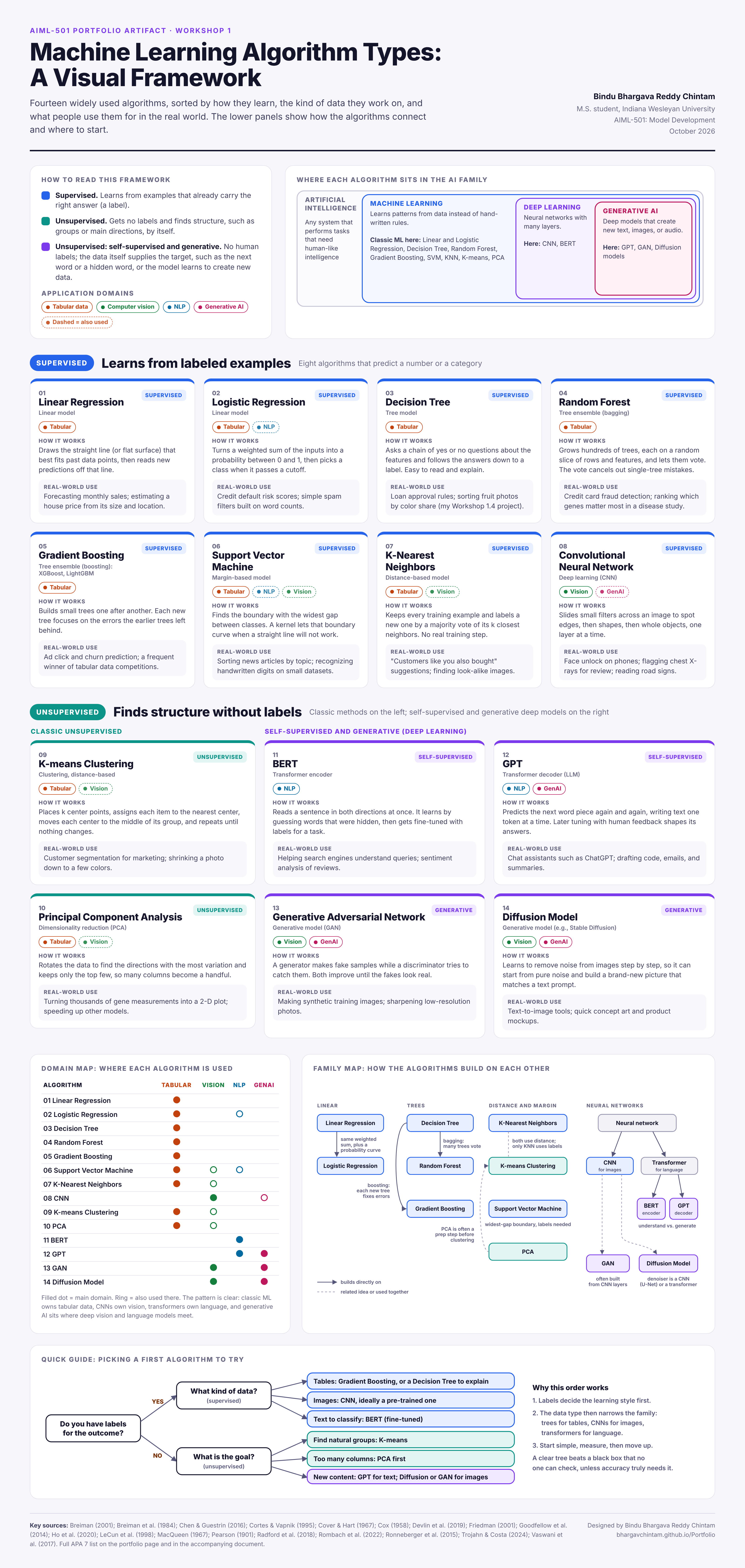
The objective was to classify at least eight to ten key machine learning algorithms by learning style and application domain, explain each one in plain language with a real example, and show visually how the algorithms relate to and differ from each other. A second goal was to make a reference I would actually use at work when a stakeholder asks why we chose one model over another.
- Picked fourteen algorithms so that every learning style and every one of the four domains had at least two strong examples, including the generative models the assignment stresses.
- Classified each one with a single question: where does the training signal come from? Human labels mean supervised; no labels mean unsupervised; targets made from the data itself, such as the next word, mean self-supervised.
- Marked each domain as a main use or a secondary use, based on what practitioners reach for first today, and checked each choice against the original papers.
- Designed three relationship views so a reader can see the same fourteen algorithms by domain, by family, and by decision path.
- Built the infographic in HTML and CSS, rendered it with Playwright to PNG and PDF, and proofread every card for accuracy and plain wording.
- This was an individual project.
This artifact shows that I can choose models with reasons, not by fashion. It connects each algorithm to the data it suits and to a real use, and it gives a non-technical reader a short path to the same decision a senior engineer would make. That mix of technical range and clear communication is the core of the value I bring to an applied AI team.
Most algorithm cheat sheets stop at a grid of names. This one shows lineage (a random forest is many decision trees voting, and gradient boosting is trees fixing each other in sequence), names where the usual supervised and unsupervised split breaks down, and links classic methods to the deep models inside generative AI. Several cards draw on my own work, such as using PCA to turn thousands of gene measurements into a readable plot.
Model selection comes up in every applied ML interview and in every project kickoff. Hiring managers want to see that a candidate will not over-engineer a tabular problem or under-power an image problem. This framework is also the base for the rest of AIML-501, where I move on to neural networks, training data, evaluation, and transfer learning, so it will keep growing with the course.
- Breiman (2001): Random forests · Machine Learning link
- Breiman, Friedman, Olshen & Stone (1984): Classification and regression trees · Wadsworth book
- Chen & Guestrin (2016): XGBoost · ACM KDD 2016 link
- Cloud Simplified (2024): AI vs. ML vs. DL vs. GenAI explainer · YouTube video link
- Cortes & Vapnik (1995): Support-vector networks · Machine Learning link
- Cover & Hart (1967): Nearest neighbor pattern classification · IEEE Trans. Information Theory link
- Cox (1958): Regression analysis of binary sequences · JRSS Series B link
- Devlin et al. (2019): BERT · NAACL 2019 link
- Friedman (2001): Gradient boosting machine · Annals of Statistics link
- Goodfellow et al. (2014): Generative adversarial nets · NeurIPS 2014
- Ho, Jain & Abbeel (2020): Denoising diffusion probabilistic models · NeurIPS 2020
- LeCun et al. (1998): Gradient-based learning for document recognition · Proceedings of the IEEE link
- MacQueen (1967): K-means, from the Fifth Berkeley Symposium · UC Press
- Microsoft (2025): Machine learning algorithms overview · Azure link
- Pearson (1901): Lines and planes of closest fit (origin of PCA) · Philosophical Magazine link
- Radford et al. (2018): The first GPT paper · OpenAI report link
- Rombach et al. (2022): Latent diffusion models · CVPR 2022 link
- Ronneberger, Fischer & Brox (2015): U-Net · MICCAI 2015 link
- Trojahn & Costa (2024): AI, ML, DL, and Gen AI compared · e-Core article link
- Vaswani et al. (2017): The transformer paper · NeurIPS 2017
Full APA 7 references are in the paper that accompanies this artifact.
Target Audience
Written for people who need to understand neural networks without building one: product managers, analysts, and new team members, along with hiring managers who want to see whether an ML engineer can teach. Each slide carries one idea, one picture, and one number from a real experiment, so a reader can follow it in a few minutes and check every claim.
A result I did not expect
Fed squared coordinates, a model without any hidden layer ought to separate the circle easily, and with two seeds it did, in under 25 epochs. With my first seed it never moved off a loss near 1.0. Working out why (a saturated output with almost no slope to follow) became one of the deck's lessons instead of a run I hid.
Real runs, native charts
I scripted the Playground runs so every setting changed one at a time under a fixed seed, then built the deck in PowerPoint with native charts, so the numbers stay editable. The colors follow Playground's own orange and blue, so readers can move between the slides and the tool.
Every slide backed by data
Adding one hidden layer of four neurons cut circle test loss from 0.532 to 0.009. ReLU learned XOR to 0.002 while a linear activation stayed at 0.496. A learning rate of 3 never settled.
23 measured training runsInside a Neural Network: Six Components and One Learning Loop
My first AIML-501 artifact compared many algorithms side by side. This one takes a single neural network apart and follows a piece of data through it. I built it in Workshop 2 because most explanations of neural networks either stay vague or jump straight into calculus, and I wanted something in between: plain words, one worked example, and proof from real training runs.
The deck groups the six components by what they do. Layers and neurons give the network its structure. Weights, biases, and activation functions shape the signal as it passes through. The loss function and optimizer form the learning loop. A flowchart shows data moving forward and errors flowing back, one slide works a single neuron with real numbers, charts compare activation functions and learning rates, and the closing slides summarize what the experiments showed.
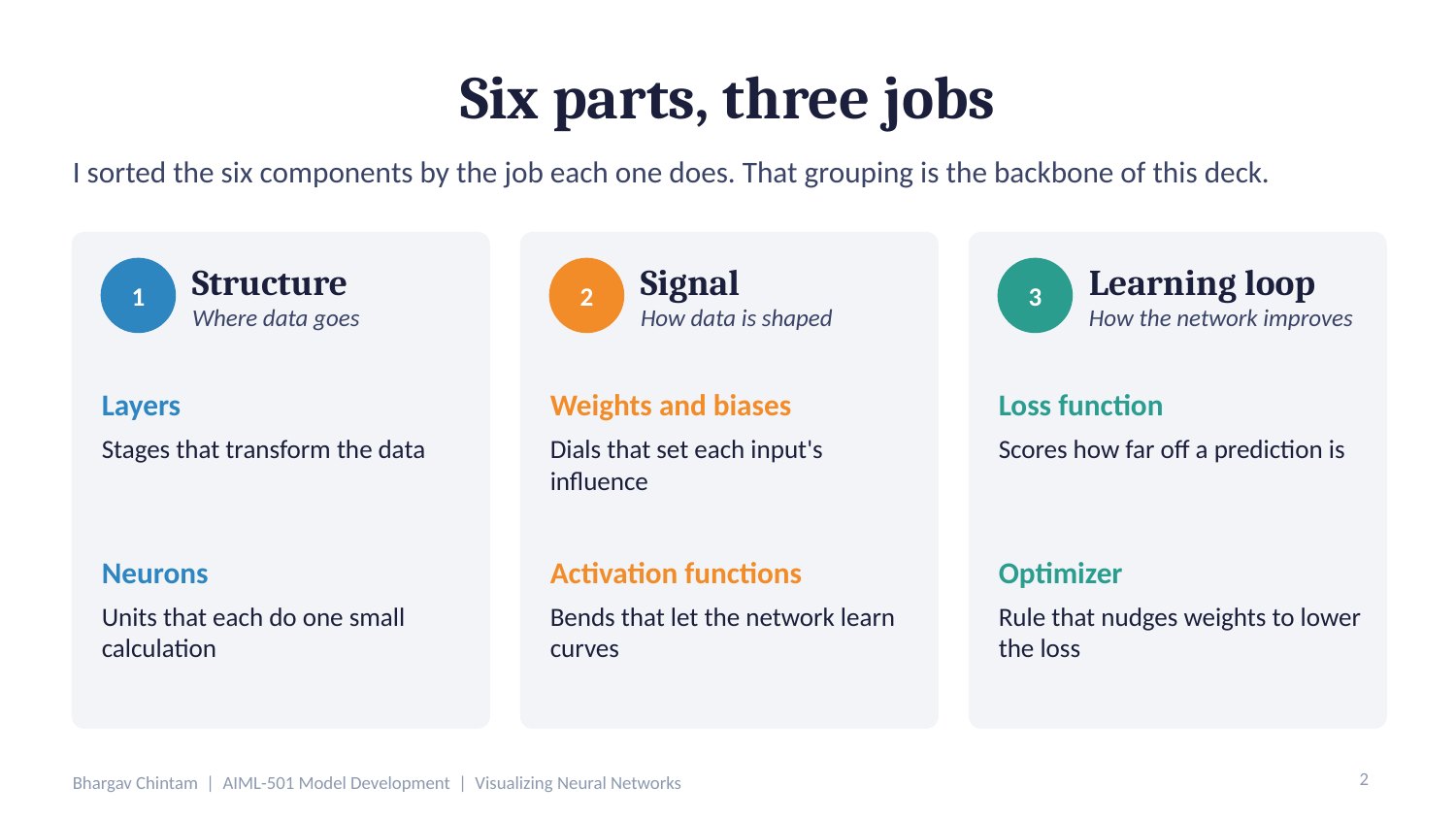
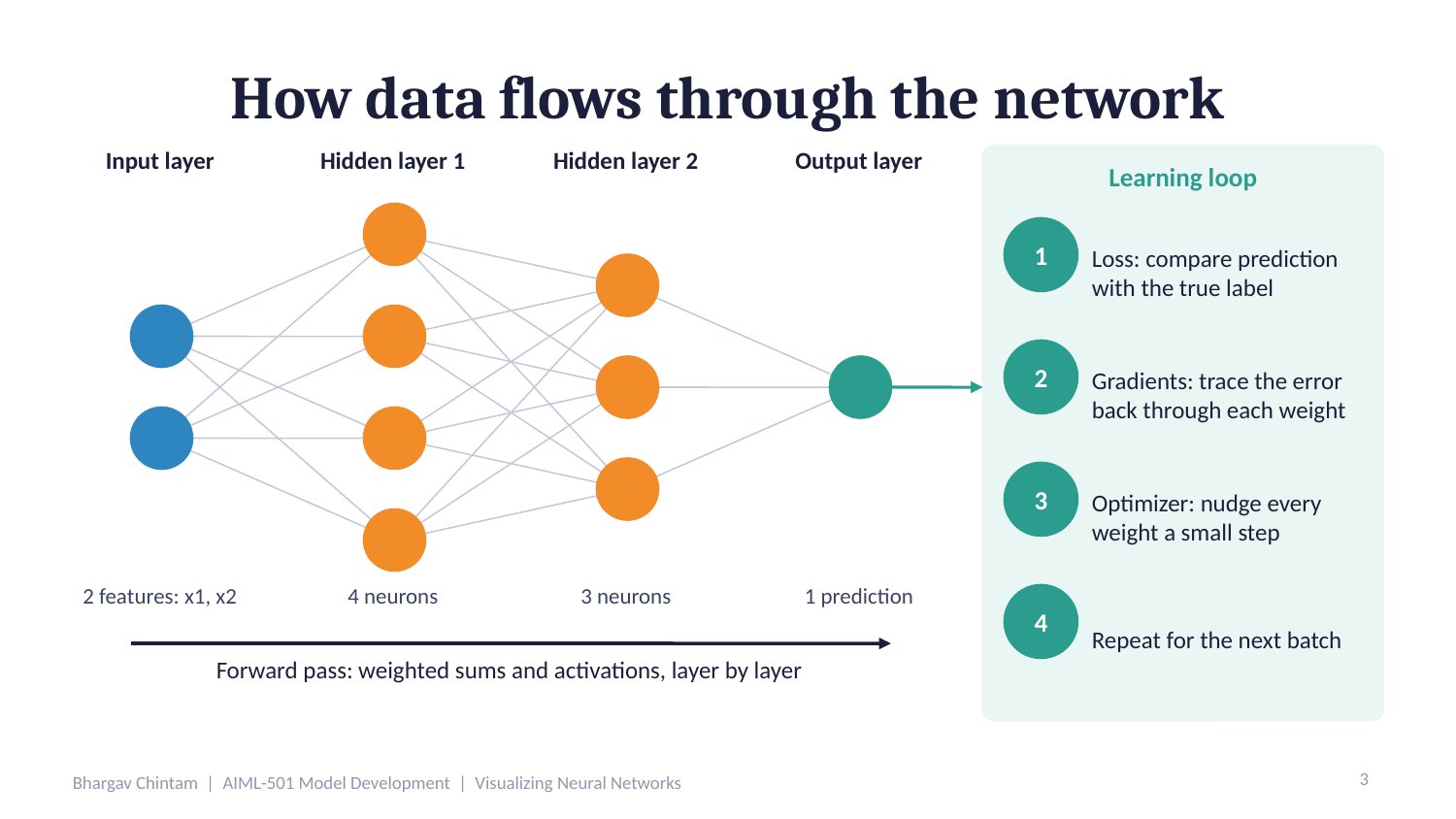
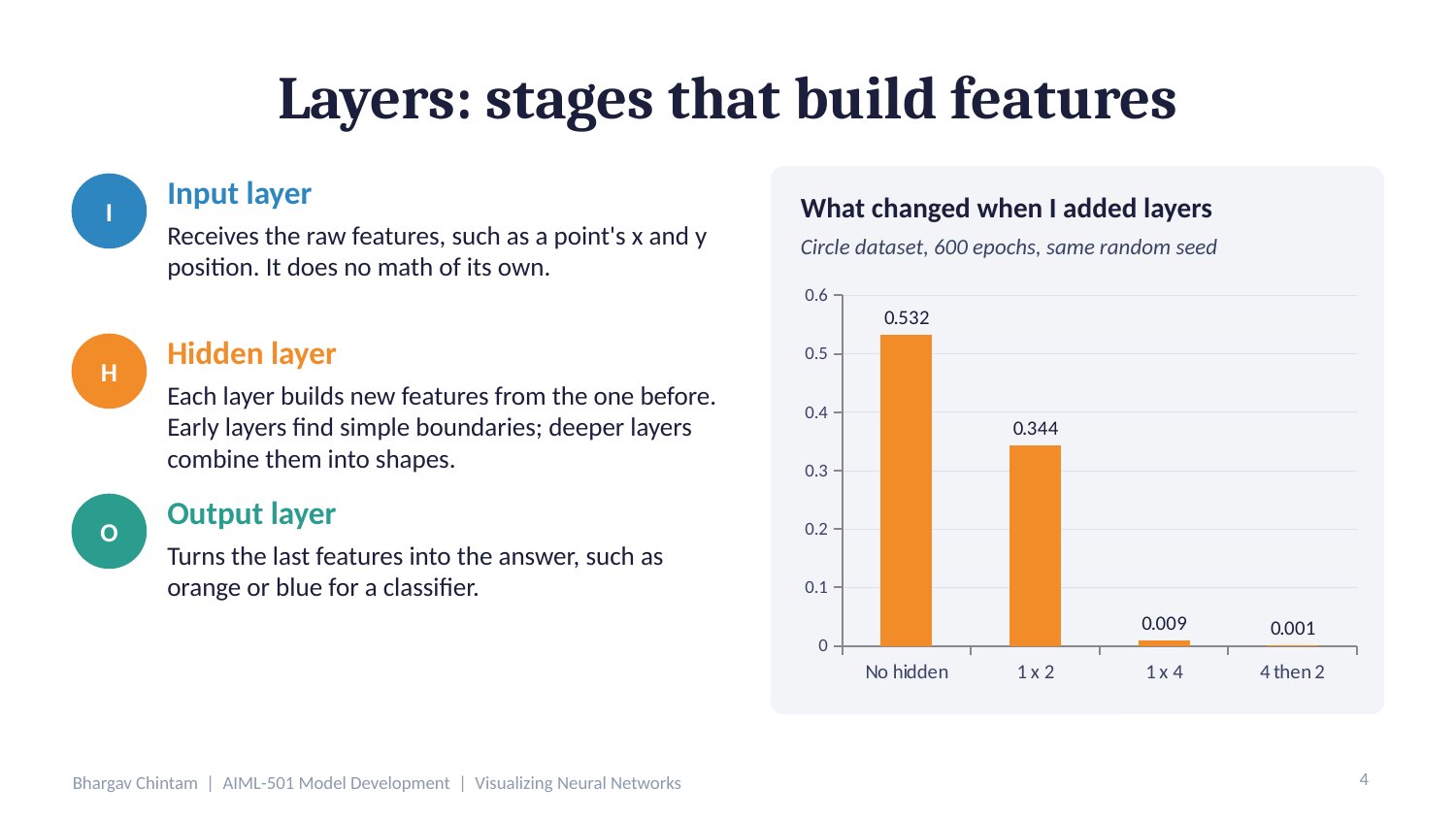
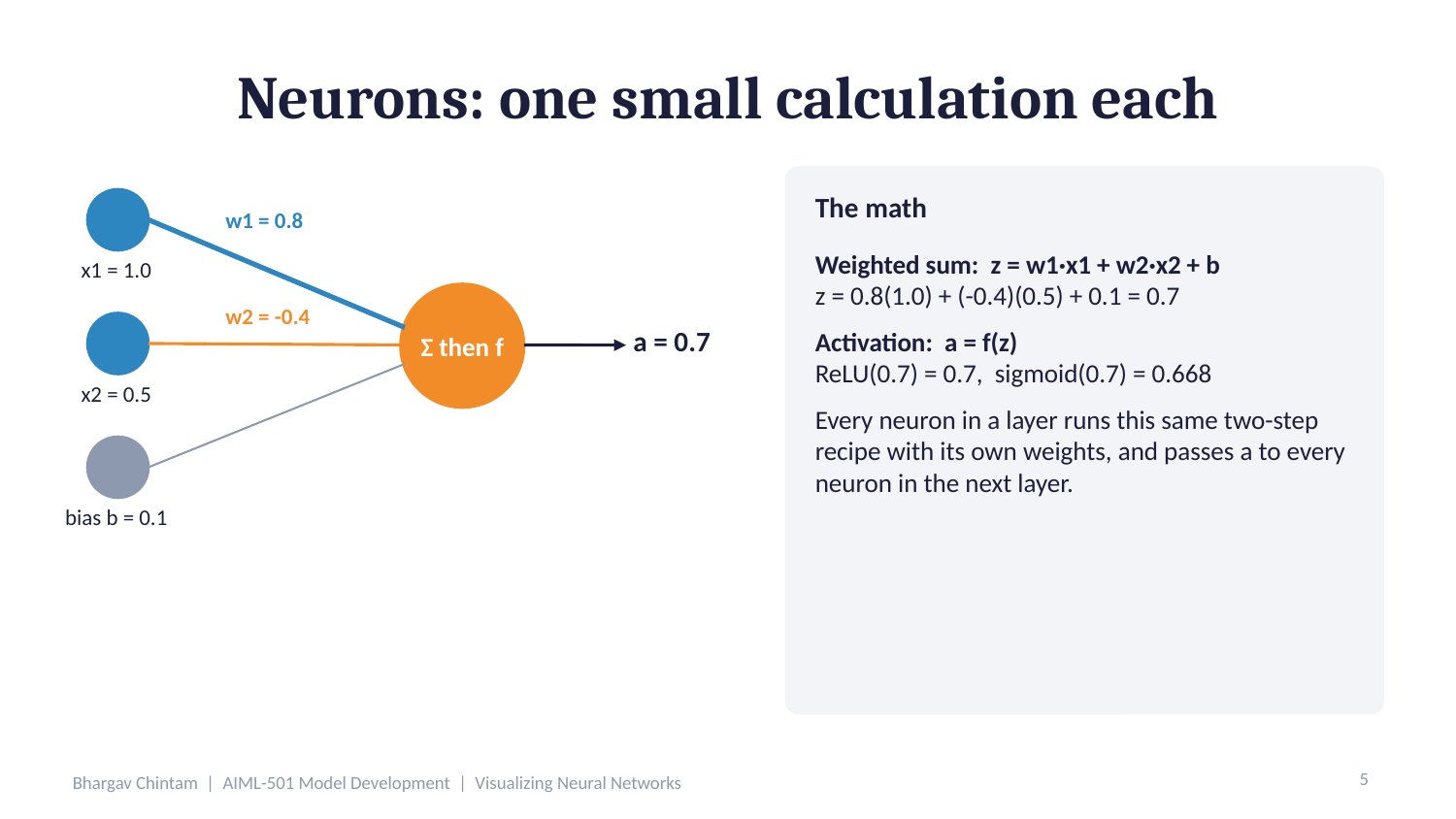
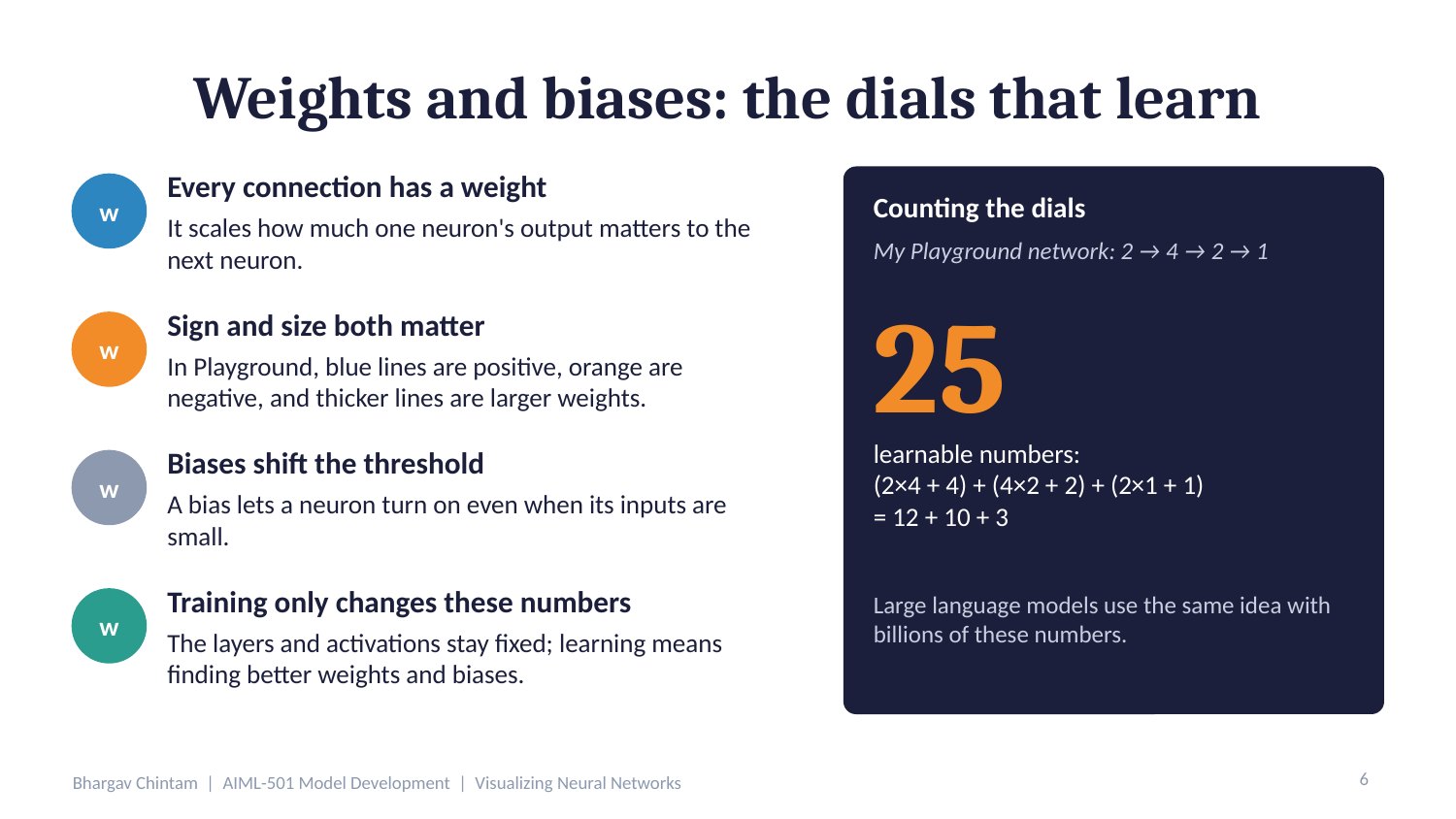
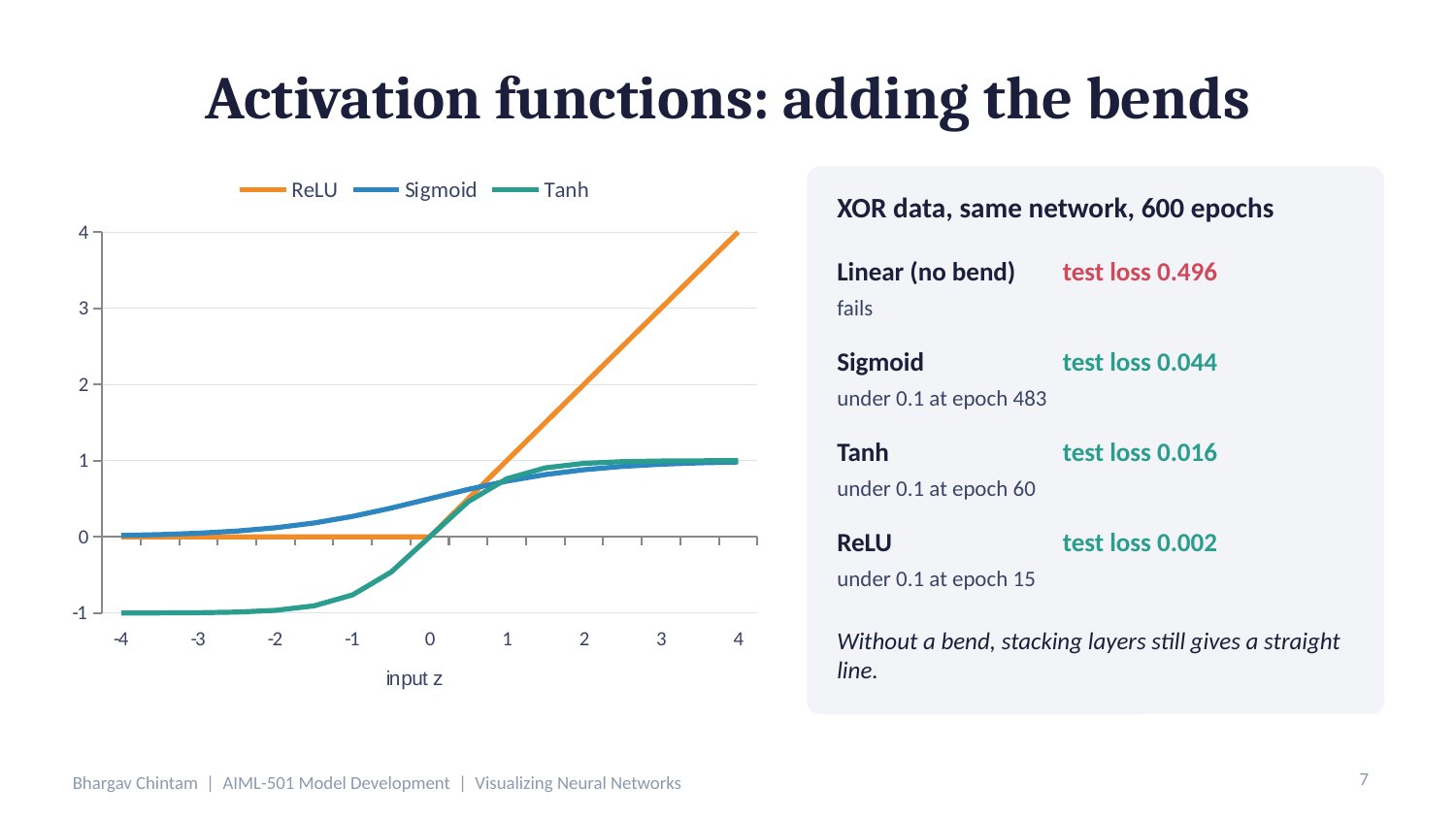
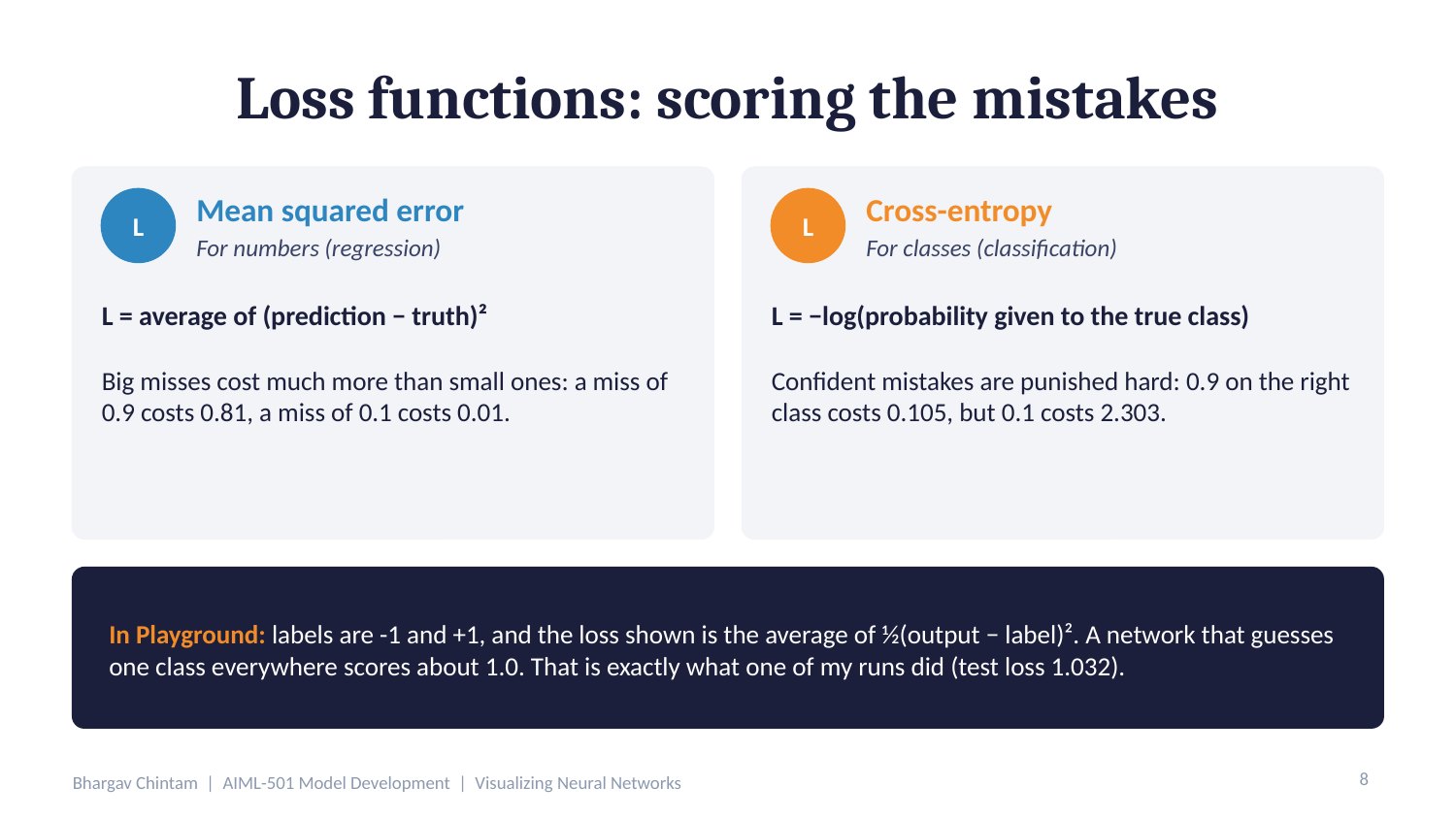
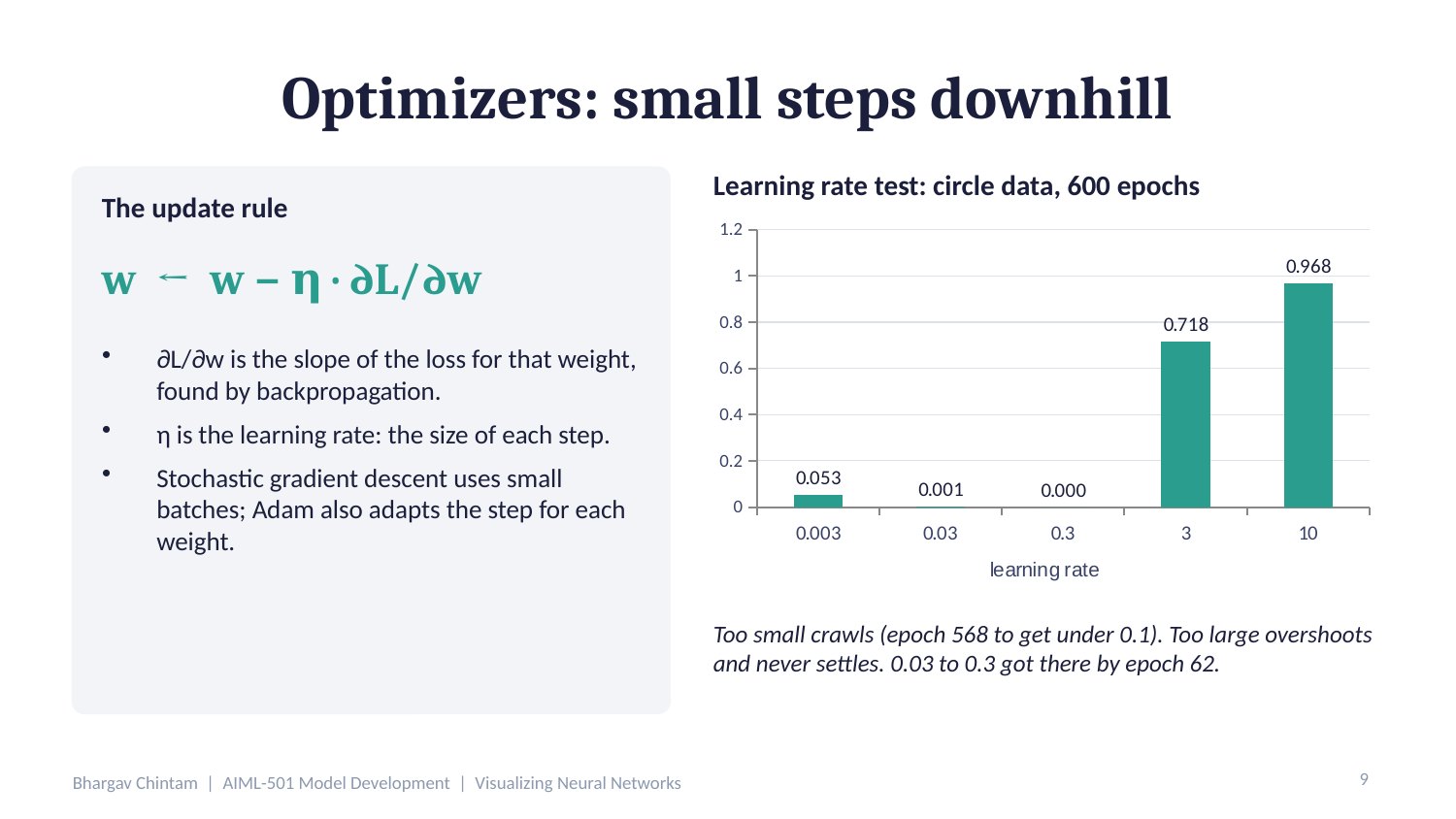
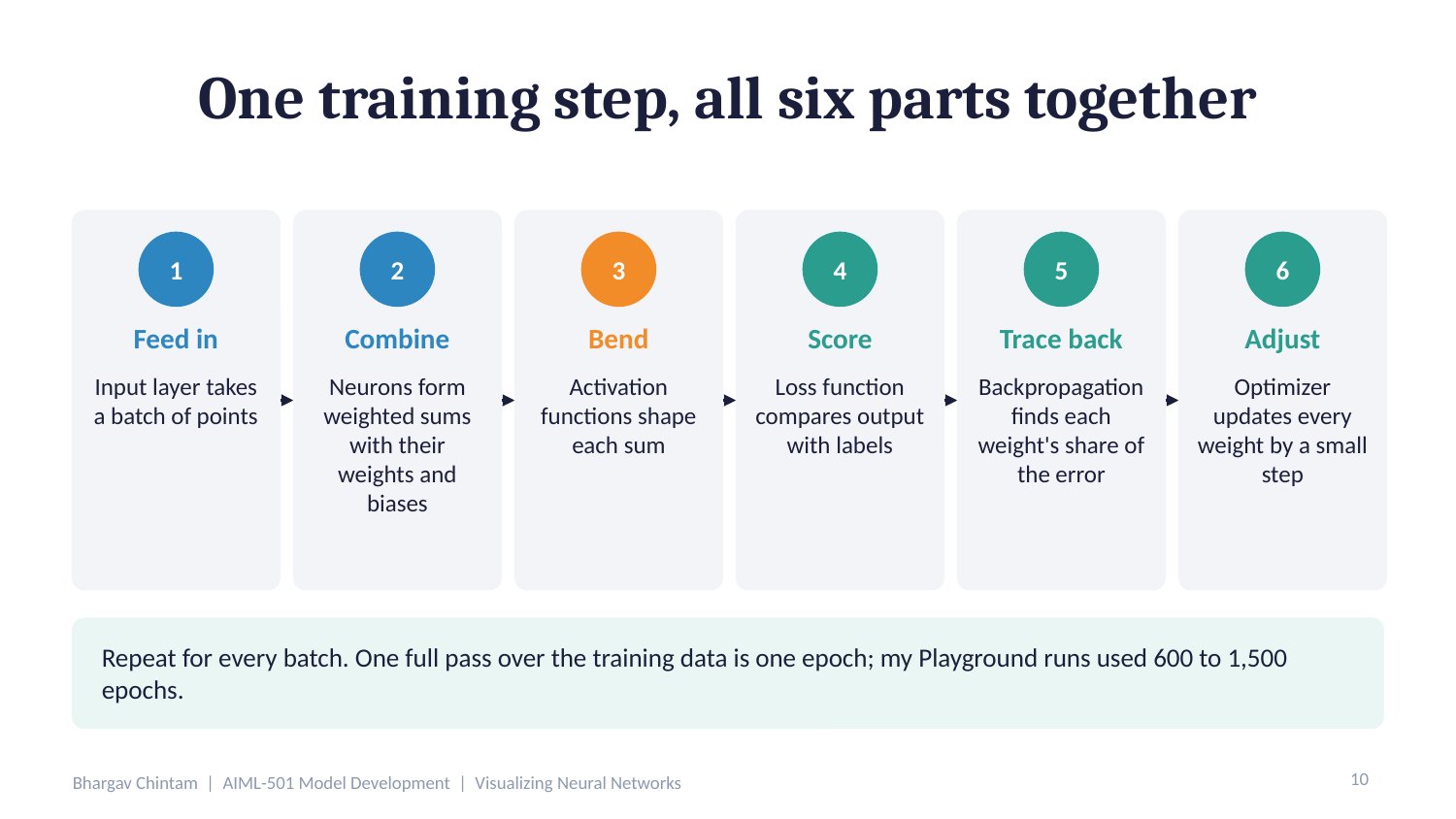
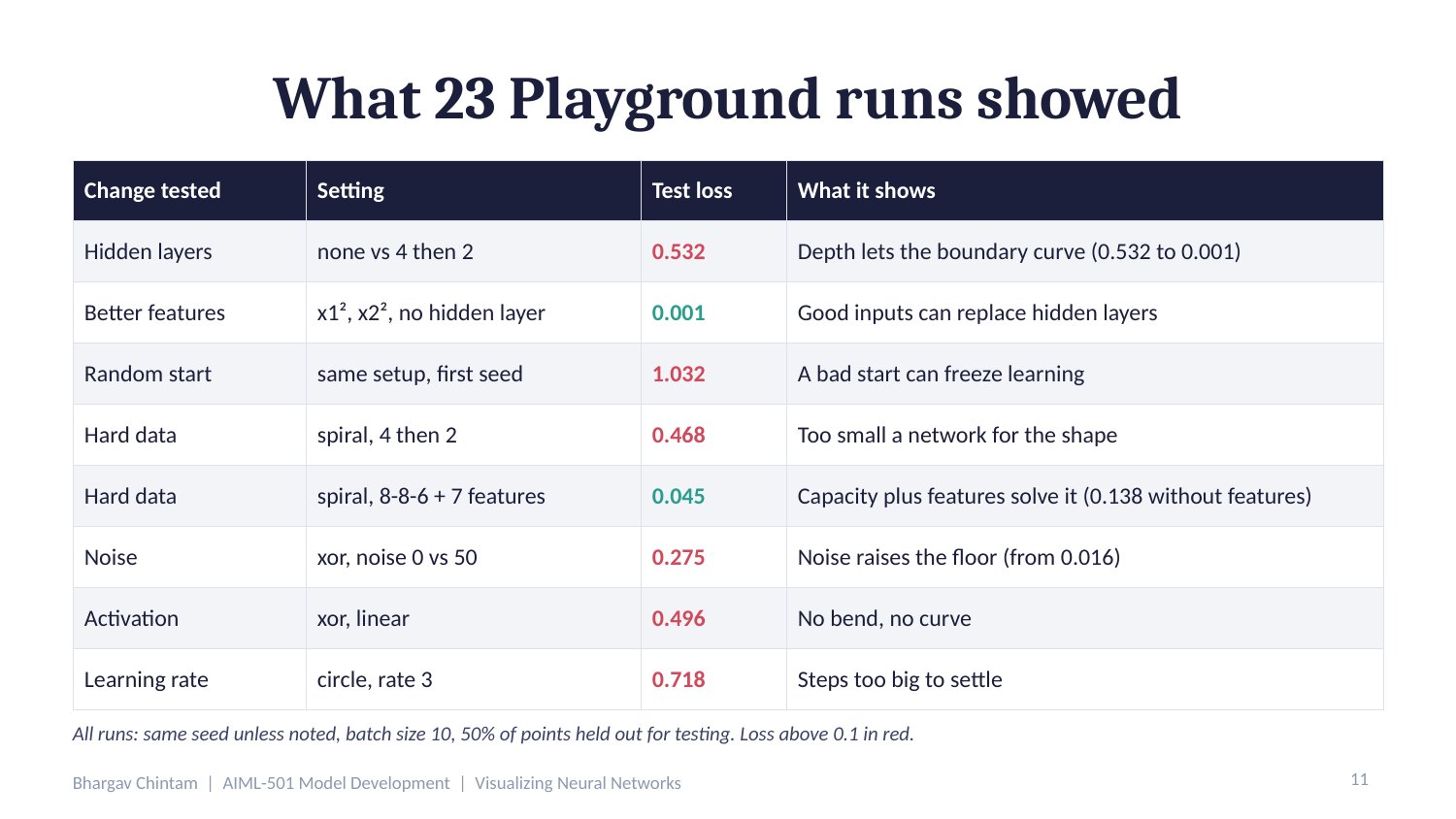
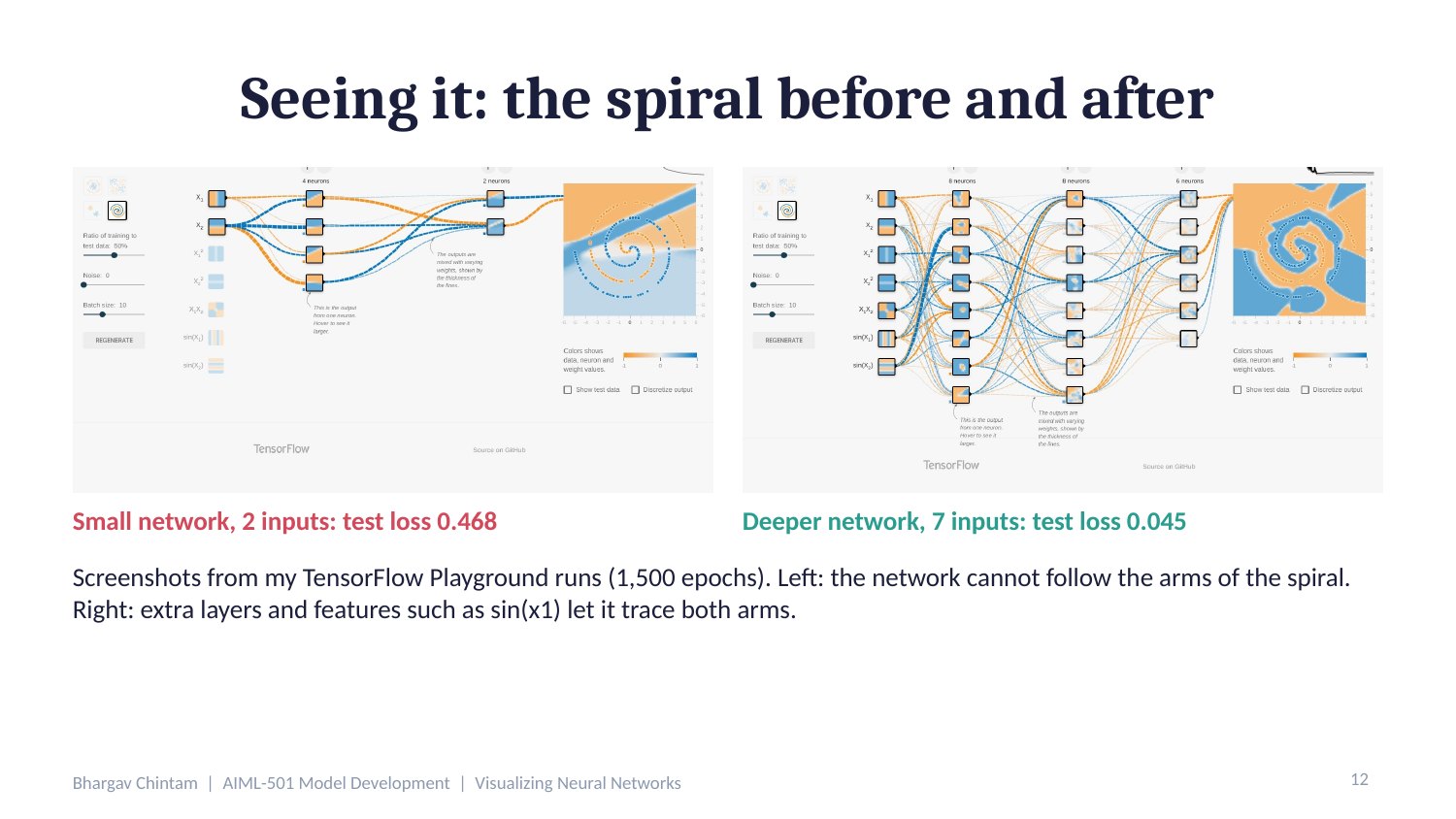
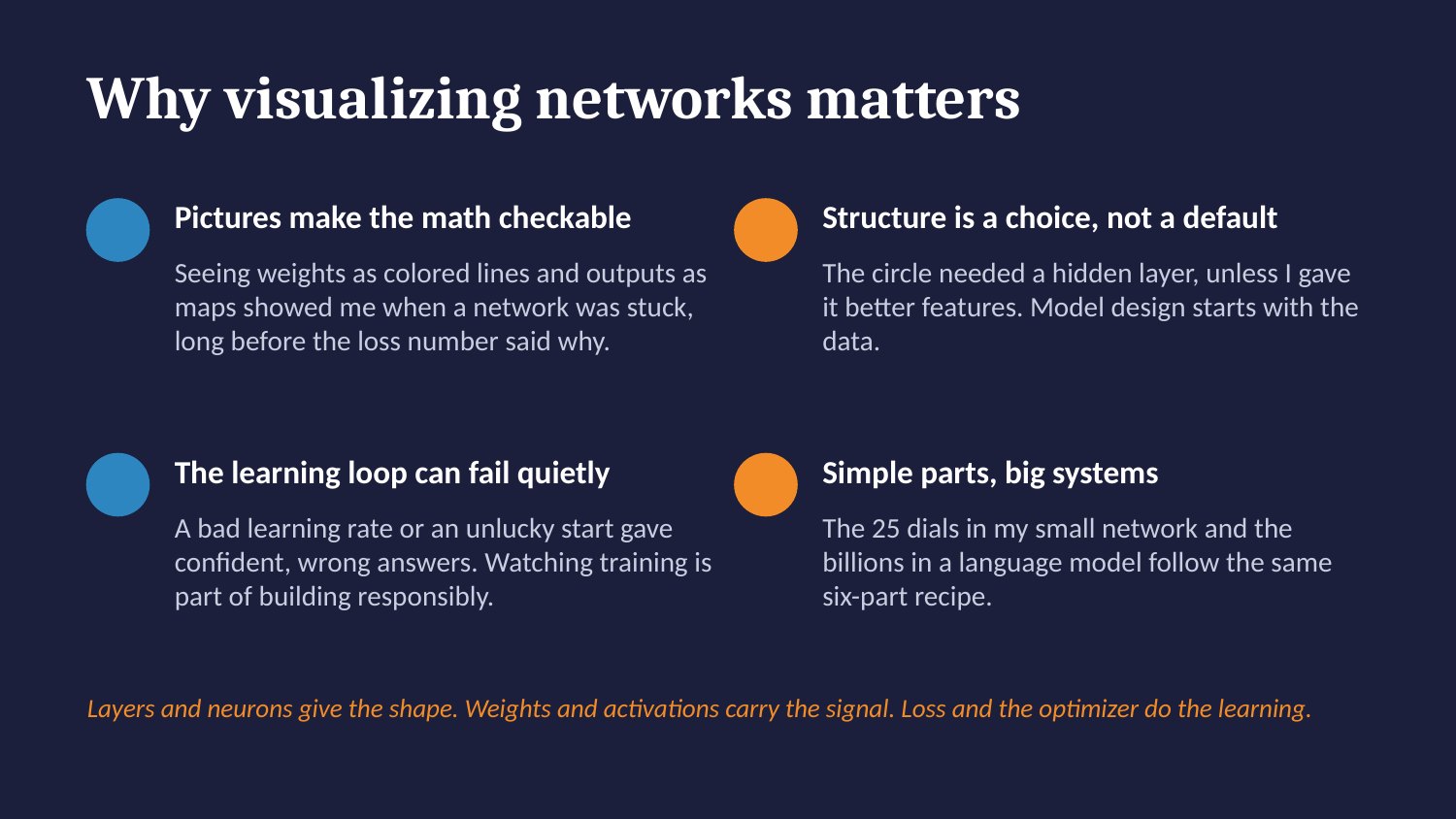
To explain all six building blocks clearly, show how they connect in one picture, and test each idea with experiments rather than just describe it.
- Ran 23 trainings in TensorFlow Playground on four datasets, changing depth, input features, noise, activation, and learning rate one at a time.
- Checked Playground's code before writing the loss slides, so the deck states exactly how the tool scores its predictions.
- Sorted the six components into three jobs and gave each job a color used across the whole deck.
- Built 14 slides in PowerPoint with native charts and a hand-worked neuron example, then checked every slide for overflow and consistency.
- This was an individual project.
This artifact shows a different strength from my first one: teaching. It turns the math of a neural network into something a non-specialist can follow, while staying exact enough that an engineer can check it. Teams need people who can explain why a model behaves the way it does, not only people who can train one.
Instead of borrowing textbook claims, every chart in the deck comes from a run I measured, including the ones that failed. The stuck-seed result and the learning-rate collapse are the kind of quiet failures that cost real projects time, and showing them openly is more useful than a clean demo.
The same six components sit inside the embedding models, vision networks, and language models I work with. Being able to explain them simply helps when a stakeholder asks why a model needs more data, why training stalled, or why a setting change made results worse.
- 3Blue1Brown (2017): But what is a neural network? · YouTube link
- Goodfellow, Bengio & Courville (2016): Deep learning · MIT Press link
- Google (2025): Neural networks module · ML Crash Course link
- IBM Technology (2022): Neural networks in 5 minutes · YouTube link
- Kingma & Ba (2014): The Adam optimizer · arXiv link
- Rumelhart, Hinton & Williams (1986): Backpropagation · Nature link
- Smilkov & Carter: TensorFlow Playground · web tool link
Full APA 7 references are in the paper that accompanies this artifact.
Target Audience
Made for managers, investors, and policy readers who hear that a model "cost $100 million" and want to know what that money buys, and for hiring managers looking for an ML engineer who can turn scattered technical reports into a clear, honest picture. Every figure is tagged by where it came from, so a reader can tell a published number from an outside estimate.
The biggest models publish the least
GPT-4, Gemini, and Claude have no public compute or energy figures, while open models such as Llama and BLOOM report almost everything. Instead of mixing the two, I gave every number a source tag: reported, estimated by researchers, my own calculation, or an executive's statement.
A data-driven web page, not a static image
My first two artifacts were a poster and a slide deck. This one is a responsive HTML page whose charts are drawn from a small data table in JavaScript, with a switch between compute, GPU-hours, carbon, and cost. The same file renders a print poster for offline use.
6 steps, 5 resources, 8 models
Llama 3.1 405B used about 121 times the training compute of GPT-3, yet energy is only 2–6% of a frontier model's cost; chips and staff make up the rest of most budgets.
21 sources cited and checkedWhat It Takes to Train a Large Language Model
Headlines about AI often quote one big dollar figure. I wanted to show where that figure comes from. This third AIML-501 artifact follows a model from raw web text to a running chatbot and puts real numbers on each step, using technical reports from OpenAI, Meta, Google, Anthropic, BigScience, and DeepSeek, plus independent cost studies.
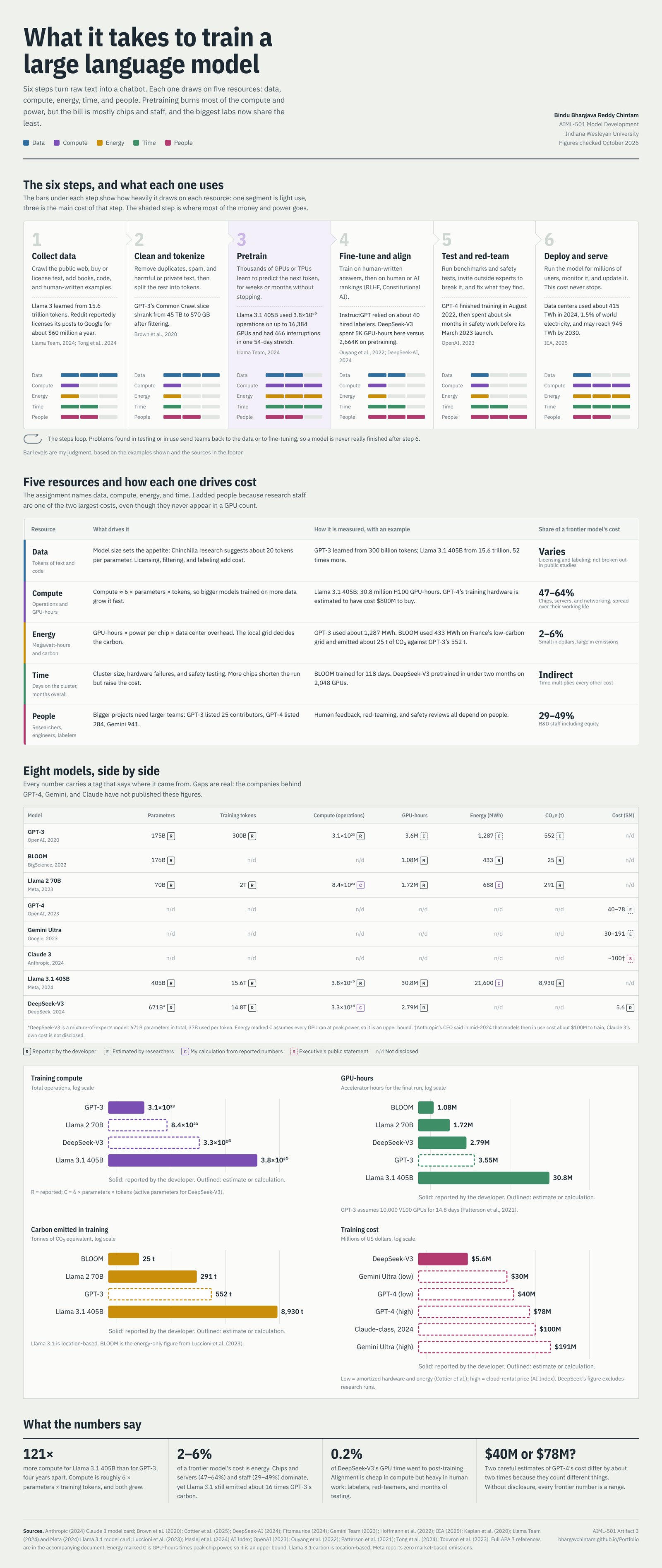
The page has four parts. A six-step pipeline (collect data, clean and tokenize, pretrain, fine-tune and align, test and red-team, deploy and serve) shows, under each step, how heavily it uses each resource. A resource table explains what drives each cost and its share of a frontier budget. A model comparison lines up GPT-3, BLOOM, Llama 2, GPT-4, Gemini Ultra, Claude 3, Llama 3.1, and DeepSeek-V3 with log-scale charts. Four short takeaways close the page.
To make the training process and its resource costs easy to follow for a non-specialist, while keeping every figure traceable to its source and honest about what is unknown.
- Read the course resources (IBM Technology, Eye on Tech, Wolfram) and the primary reports behind each model.
- Pulled figures straight from the source PDFs and model cards, and noted where each one came from.
- Filled a few gaps with transparent arithmetic, such as compute from 6 × parameters × tokens, and labeled those values as my own.
- Designed and coded the page, checked it on desktop and phone widths, and rendered a poster version.
- This was an individual project.
Artifact 1 showed I can sort algorithms and Artifact 2 showed I can teach how a network learns. This one shows research and data communication: reading dense reports, checking numbers against each other, and presenting uncertainty plainly. That skill matters whenever a team has to budget for training or defend a build-versus-buy decision.
Most graphics about AI cost show a single number per model. This one shows the evidence behind each number, places people next to chips and power as a real cost, and keeps blank cells blank instead of guessing.
In my own work I decide whether to train, fine-tune, or call an existing model. Knowing that pretraining dominates compute while alignment and testing dominate human effort helps me plan those projects and explain their costs to decision makers.
- Brown et al. (2020): OpenAI report describing the GPT-3 data and compute link
- Cottier et al. (2025): Epoch AI cost estimates for frontier training runs link
- DeepSeek-AI (2024): technical report with DeepSeek-V3 GPU-hours and cost link
- IEA (2025): International Energy Agency outlook on data center power link
- Kaplan et al. (2020): OpenAI study linking compute, model size, and data link
- Llama Team (2024): Meta report on training the Llama 3 models link
- Luccioni, Viguier & Ligozat (2023): measured energy and carbon for BLOOM link
- Maslej et al. (2024): Stanford annual report with training cost estimates link
- OpenAI (2023): GPT-4 report with its training and safety timeline link
- Patterson et al. (2021): Google estimates of GPT-3 energy and emissions link
- Touvron et al. (2023): Meta report with Llama 2 GPU-hours and emissions link
- Anthropic (2024): model card describing how Claude 3 was trained link
Full APA 7 references are in the document that accompanies this artifact.
Target Audience
Built for non-technical decision makers, such as clinic managers, compliance officers, and executives, who are asked to approve AI tools and want to know whether "the model can explain itself" means anything. It also shows hiring managers that I can translate fast-moving research into plain guidance.
The research moves faster than the vocabulary
Terms like sparse autoencoders, attribution graphs, and chain-of-thought monitoring mean nothing to most readers. I rewrote each one as a question a manager might ask, such as "What does the model say it did?", and kept the technical names in the references.
A problem-to-tool matrix you can click
Earlier artifacts were a poster, a slide deck, and a data page. This one is a concept matrix: picking a challenge highlights the techniques that address it. The fonts were chosen for readability, including Atkinson Hyperlegible, which was designed for low-vision readers.
5 challenges, 4 technique families, 4 checks
In tests, reasoning models admitted using a planted hint only 25% to 39% of the time, which is why the map treats self-explanation as a clue that must be checked.
19 sources cited and checkedOpening the Black Box: How We Explain and Check Large Language Models
More organizations are being asked to trust chatbots with real decisions, and new rules such as the EU AI Act give people a right to an explanation when high-risk AI affects them. My fourth AIML-501 artifact asks a simple question for a busy reader: when a company says its model is explainable, what does that actually cover, and how would you know?
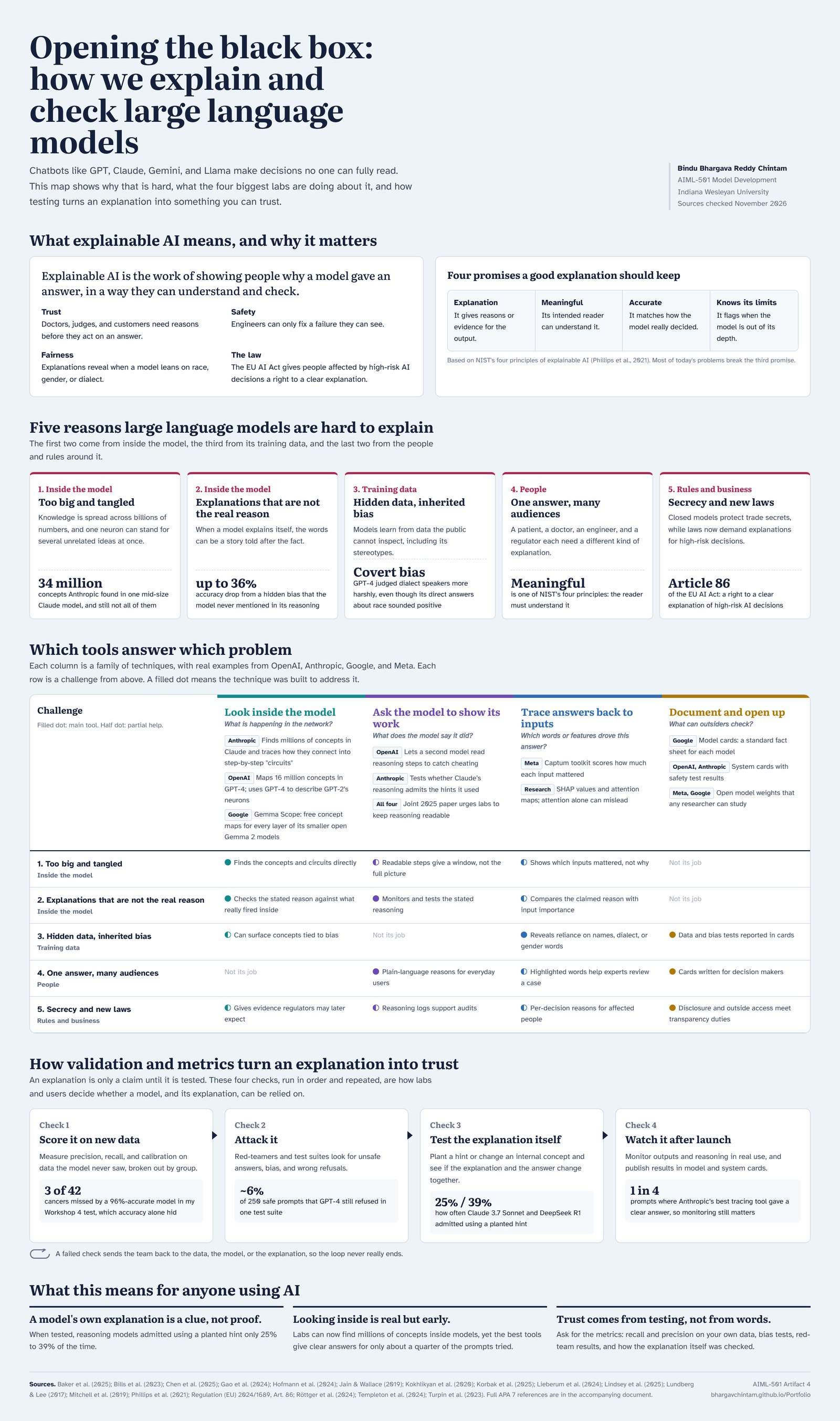
The page opens with a one-line definition, four reasons explanations matter, and NIST's four principles of a good explanation. Five challenge cards follow, grouped by where the difficulty comes from: the model itself, its training data, or the people and rules around it. The center of the page is a matrix with those challenges as rows and four technique families as columns, each with real work from OpenAI, Anthropic, Google, and Meta. A four-step validation loop and three plain takeaways close the page.
To help a non-specialist judge claims about AI transparency by showing which explanation methods address which problems, and which tests prove that an explanation is honest.
- Read the primary research from each lab and pulled one measured number for every challenge and check.
- Sorted the challenges by where they come from and the techniques by the question they answer.
- Linked each technique to each challenge as a main tool, a partial help, or not its job, and wrote one line on why.
- Tied the validation loop to my own Workshop 4 work on metrics and red-teaming.
- Coded the page, tested it on desktop and phone, and exported a poster. This was an individual project.
The first three artifacts showed classification, teaching, and cost research. This one shows AI governance thinking: knowing the limits of current explanation methods and turning them into questions a buyer or regulator can actually ask a vendor.
Most explainers list techniques. This one connects each technique to the problem it solves and to the test that checks it, and it is honest that a model's own explanation can be wrong.
In clinical and genomics work, a prediction nobody can explain rarely gets used. The matrix is the checklist I would bring to any review of an AI tool for a high-stakes setting.
- Chen et al. (2025): Anthropic study testing whether reasoning models admit the hints they used link
- Gao et al. (2024): OpenAI work mapping millions of concepts inside GPT-4 link
- Korbak et al. (2025): joint paper from several labs on keeping model reasoning readable link
- Lieberum et al. (2024): Google DeepMind tools for studying the open Gemma 2 models link
- Lindsey et al. (2025): Anthropic tracing of step-by-step circuits inside Claude link
- Kokhlikyan et al. (2020): Meta toolkit for scoring input importance link
- Mitchell et al. (2019): proposal for standard model fact sheets link
- Phillips et al. (2021): NIST principles for good AI explanations link
- Templeton et al. (2024): Anthropic feature-finding study on a Claude 3 model link
- Turpin et al. (2023): study of reasoning that hides its real cause link
Full APA 7 references are in the document that accompanies this artifact.